Tesco - The legacy
22 October 2019
The news that the Tesco half-year results brought us, in terms of the Dave Lewis departure date came as somewhat of a surprise. I think everyone knew there was a chance that it could be soon, was the second part of the job too much after the energy needed to turn around the chain? Or would Dave stay on to create a new legacy?
The first option, whilst not entirely true is probably close to the reality for Dave Lewis. The turnaround, whilst we forget (seemingly) how bad Tesco was and the apparent ease in which they've sorted themselves out takes significant energy. That's without the sideshow of the court cases for accountancy issues, overseas businesses and a bonfire of sub-brands, alongside trading in an ever-competitive market place.
We will, of course, take stock, look back over the years and what Tesco have been doing to recover (what looks like) a stable margin, their work at the shelf edge which has been relentless in terms of repositioning own label versus branded product and introducing everyday pricing and value (following Sainsbury's down this route).
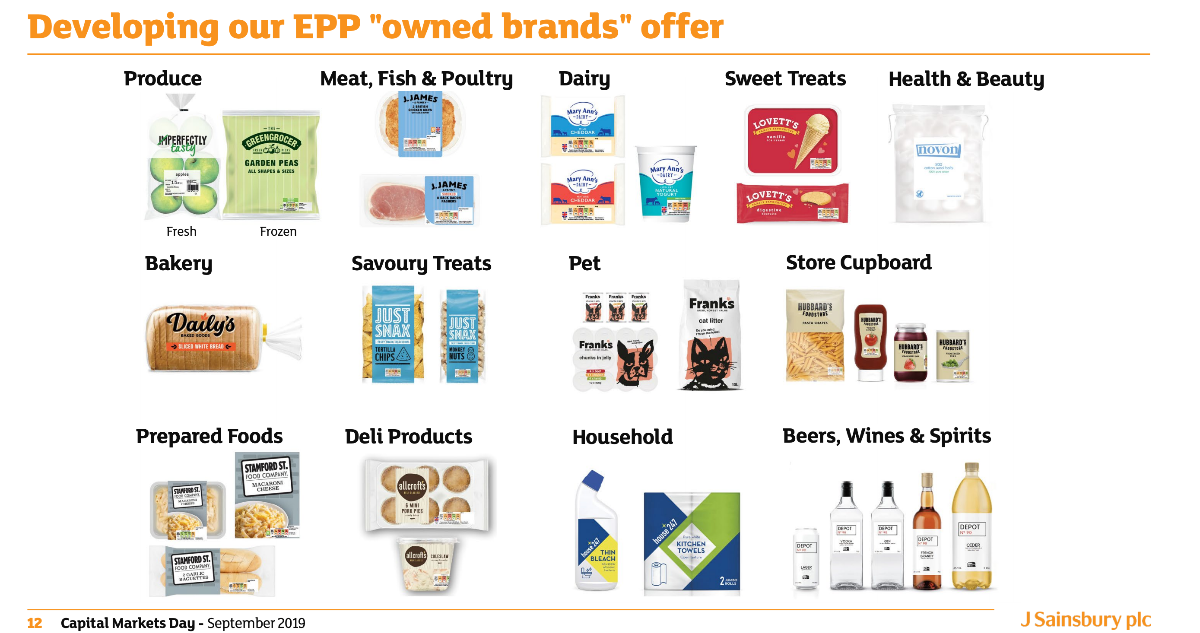
The first slide from the JS capital markets day (analysis to come) details their "EPP" (entry price point) owned brands offer. Which, if we are to give credit to Sainsbury's for being the first to simpler pricing, fewer promotions and the like.
Then equally, the hat has to be tipped to Tesco for their work around "Farm brands" and then 'value' brands which have seen pushback on to discount with their limited range of entry tier products and the comparables between those and the own-label products that discounters sell.
This has seen Sainsbury's imitate this strategy with their stable of heritage brands that have a resonance with the company's history (highlighted on this service, long before anyone else really noted these) such as Stamford St (former HQ), Mary Ann's dairy (Mary-Ann Sainsbury of course) and J.James (Sainsbury).
There are a number of other products to drop into stores in the coming weeks but the JS capital markets day struck a positive tone on their work with value tier products and the numbers they are delivering. As noted in a previous note, whether this merely "bookends" the offer (IE more buy into lower price product and then trade customers into those smaller, higher-priced, higher-margin products too).
However, Sainsbury seemingly says 'not so' and have been hard at work on their value proposition post the Asda merger being abandoned. More on JS in the next note to subscribers.
For Tesco - Dave moving on means a new man at the helm, Ken Murphy of Boots Walgreens and a lifer in a similar industry. Although perhaps with more retail experience than Dave, both experienced in a sector which is heavily focused on brand perception and higher-margin products.
It's difficult to identify what he may seek to do, he inherits a business in far better shape than the one Dave inherited which is a positive but there haven't been many bumps in the road for Dave Lewis in his tenure, in terms of results at least.
The longer handover period (Lewis is in situ for 12 months) will also help and Murphy will face into the space issue (Tesco are still over spaced, like many retailers), what to do about Jack's (roll-out, roll back or abandon?), overseas operations, online growth and the continuing rise of discounters...
Can Booker yield further successes for the enlarged chain too? What about the Carrefour buying alliance, is that doing anything for anyone in the two firms?
All of this can be questioned at a later date, but their half-year results, alongside the Lewis departure date (which he selected, which is basically the highest accolade a retail CEO can have, the reverse is to be bundled out of the back door with sales tanking), there were some interesting bits in the Tesco presentation which we shall digest now.
Then we'll look at the JS Capital markets day, letting the dust settle as I'm aware we've been a bit JS heavy on this service for some time.....
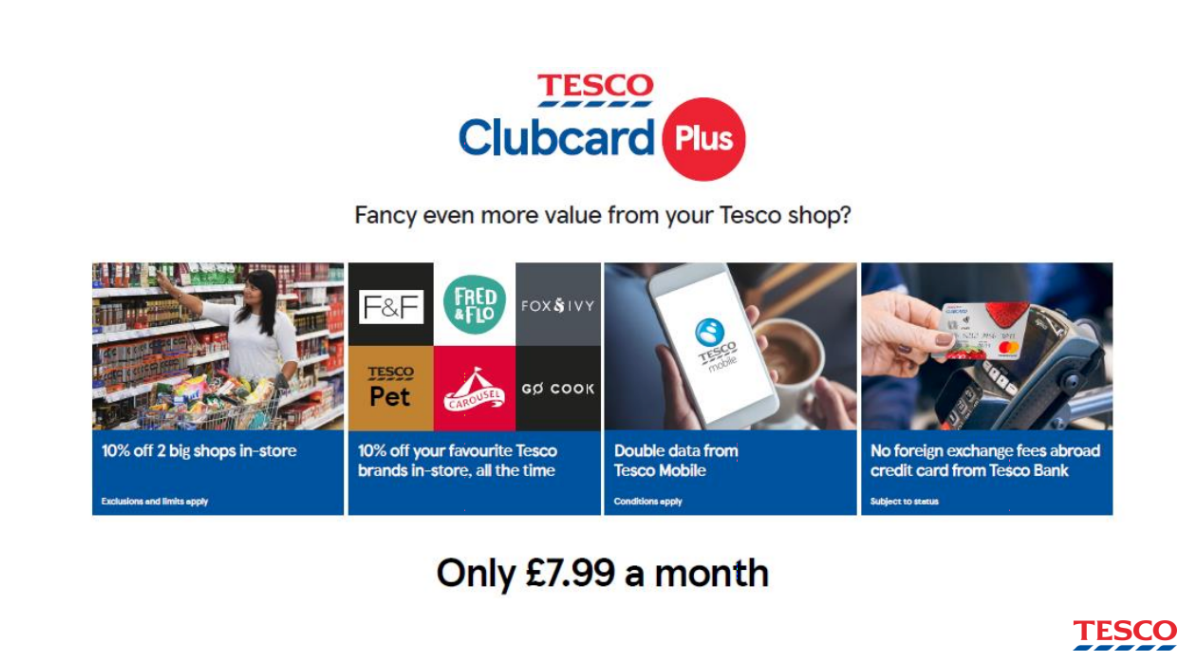
Old news now; but the launch of Tesco Clubcard Plus is intriguing, lots of naysayers. 'who would buy this' etc. The same people who were screaming for the digitisation of Clubcard no doubt and expressing concern Tesco were having their backsides handed to them by Amazon Prime.
So they respond, eventually with an offer that no one has to take up, but in reality, numerous customers will do so, especially those 'loyalists' given the ample discounts on own label, clothing and non-food too.
If the customer is within the 'walled garden' then they will spend more with that retailer out of habit and obligation (IE I am spending £8 already a month so may as well go to Tesco for discounts etc). It becomes an easier method in which to be 'top of mind' for the customer when they think about food shopping.
In the same way that the delivery saver memberships work online, the customer, paying £6/£10 a month for 'free' deliveries will likely use that retailer for their online food shop. For the retailer, some customers will use it religiously but some customers may treat it like a gym membership - IE uses once / twice / infrequently but not use until the following Christmas.
It's a low-risk piece of work from Tesco and the thought for the day is what if Tesco had done this a number of years ago, rather than waste hundreds of millions on various businesses that served only to take resource in terms of cash and people away from the core business?
Links with the delivery saver remain to be seen though, can you combine both?
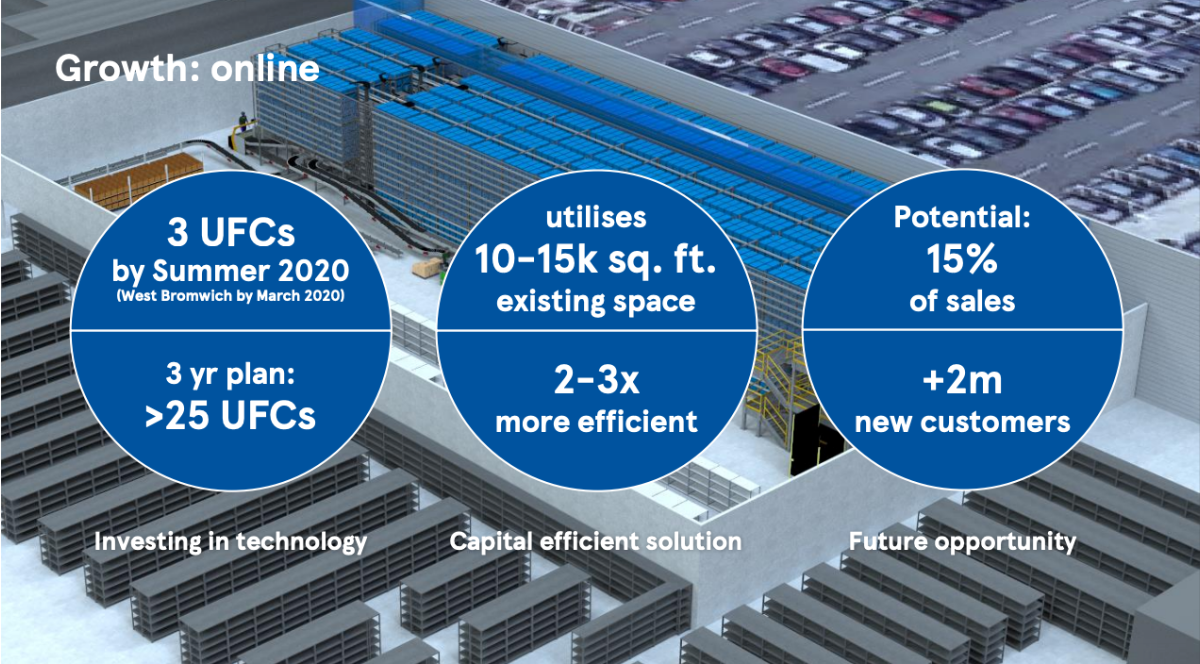
A smart move and one of the suggestions for Dave all those moons ago on the blog I believe, repurposing space via a wholesale offer (IE their own, but they bought Booker) but also consideration was to offer more online picking in mini dark stores.
Certainly from a viewpoint of Tesco, they are blessed with space and despite having done a number of closures, secondary concessions (Pets at Home, Arcadia etc) there are still stores that are too big.
Especially given the tighter ranging, greater space for faster-selling products, means that space just isn't required and 'keeping the lights on' in under-occupied areas of the store means the store numbers start to make less sense - resourcing larger stores, with lower sales purely on space is then a challenge in itself.
But the online conundrum remains thus, there is a serious problem with capacity in online. Where a store is able to expand on space to sell faster-moving products, online deliveries rely on the number of 'vans' as the general currency of trade levels.
Naturally, there is a limit on the number of products that can be fit onto a van, or physically picked in a store without impacting availability. if you're ever in a store early on in the trading day, you can expect to see gaps on the shelf without the customber numbers to justisfy it.
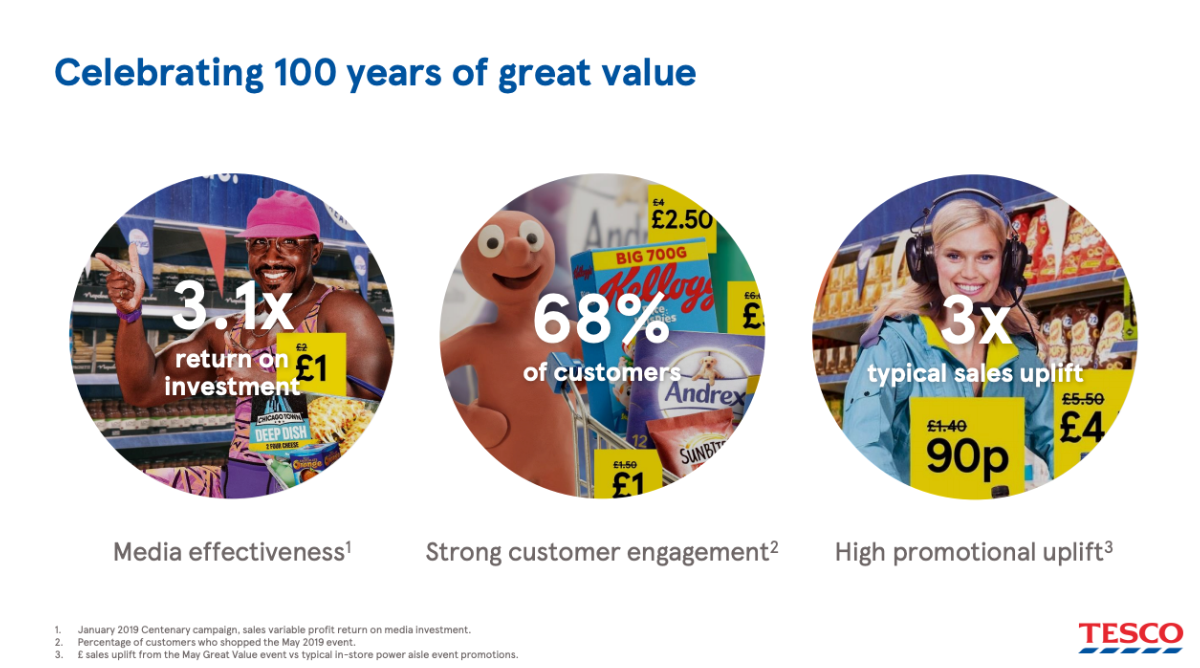
Their value campaign has been strong and continued well throughout the 100-year campaign this year. Strong media campaign too, using retro icons like Anneka Rice and Morph!
It has played right into the retro trend too.
A big challenge for Tesco is space and it remains a challenge in terms of how to repurpose this excessive space, especially if sales fall due to competitive activity for example. In addition, there are improvements around supply chains, less working capital needed via less stock on shelf etc.
Coupled with rising wages and rising costs mean that larger stores need to pull their weight, thus the dot com picking element makes sense, repurposing space and aiding the capacity within online.
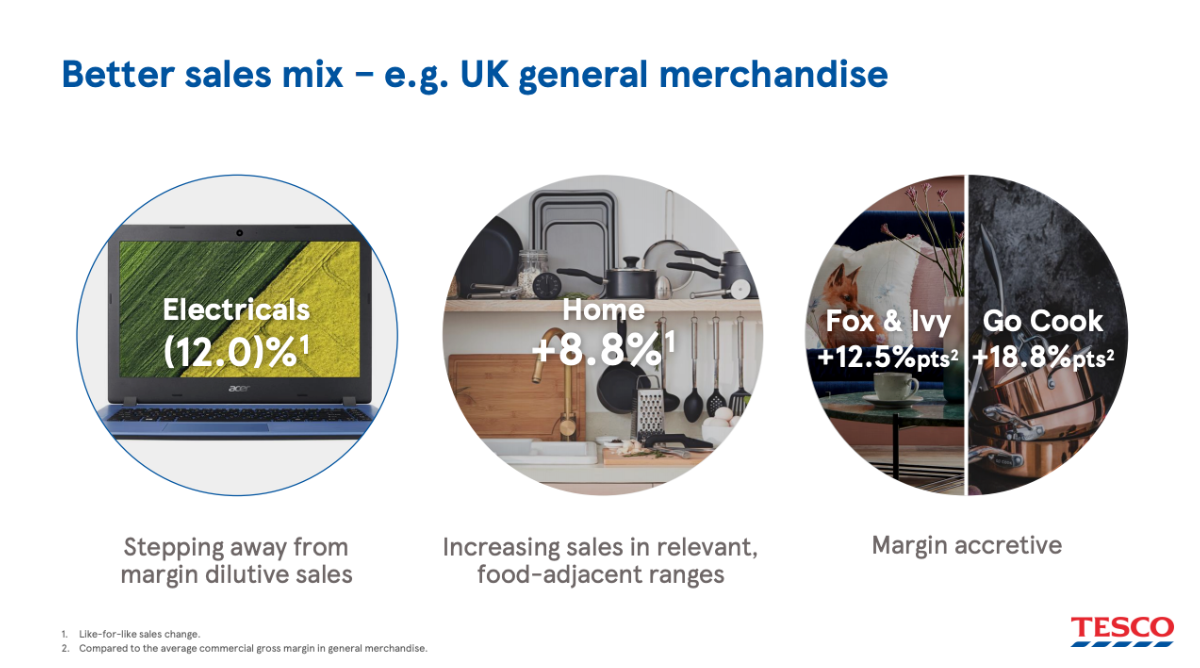
A key achievement of Dave Lewis is moving the business away from low margin, non-food sales. A risk given Sainsbury's acquisition of Argos and the growth of online and the 'ease' of shopping for customers.
However, the market is slowing and the non-food growth has all but disappeared. If anything, customers are buying more online and more from specialists. The margins are low in growth areas such as electricals and Tesco view that the loss of c.£40m on direct (including fulfilment from click/collect etc on Express stores) as being unsustainable.
Can you grow a business relying on footfall for non-food? Certainly, Sainsbury's have a more sustainable brand in its own right in Argos, alongside a strategy to utilise space with sub-branches in Sainsbury's stores.
The reality is that despite the move away from non-food en masse as a strategy, there has been a growth in richer margin sales. Rather than merely trying to grow a food business on the back of the non-food business, which was the case in the past perhaps.
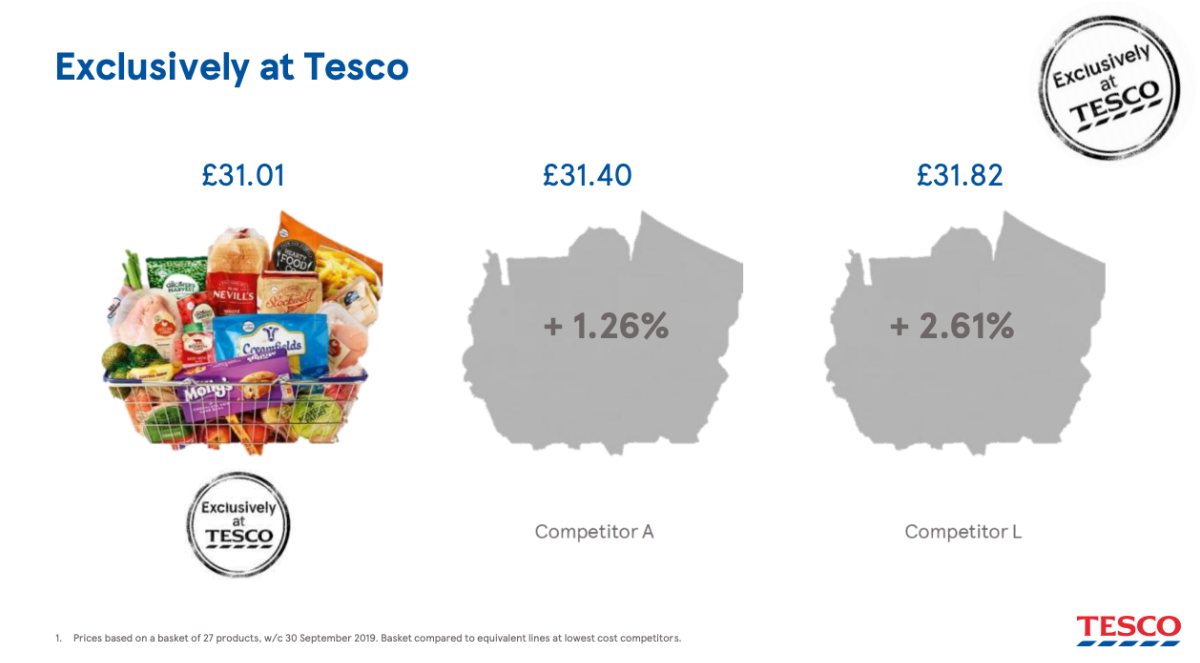
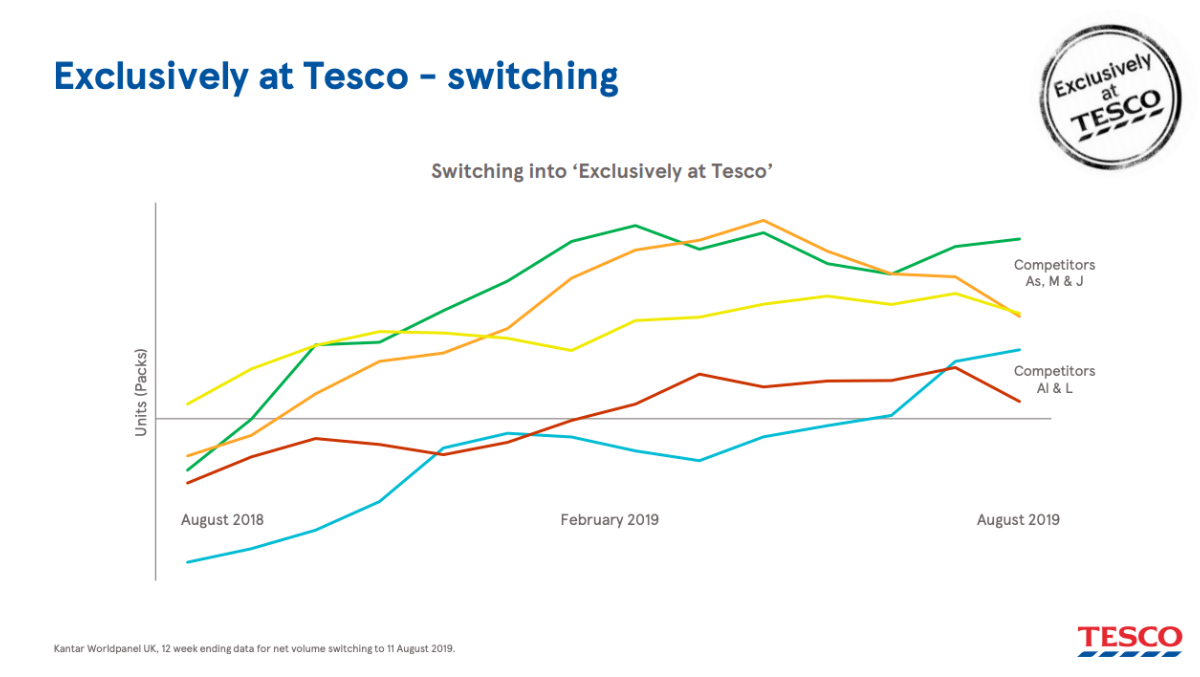
A good piece of work and piggybacking on to the back of the Tesco Ireland strategy (low prices versus discounters) albeit on own-label ranges has worked well in terms of improving value perception in a stronger way for customers.
Aiming to stop that 'leakage' to discount on lines where there was a value gap, such as cooked meats perhaps sped up the decline of the Deli counter. However, there has been a real tit for tat battle with discount on their value products with price movements all over.
The margin dilutive work done by enhancing the value tier is always risky, but Tesco had done all their spadework with the enhanced presence in the fixture, moving brands down the fixture and moving own label to the eye level. Sharpening exposure and thus price perception.
The difference in the discounter model means that they can offer their 'mid-tier' products at a lower price, we know this. Customers see this and there is still a gap, even in perception but the value tier being developed and aligned with discount mid-tier can cause question marks, even at a basic level.
The adoption of Tesco mid-tier packaging design by Aldi in Frozen was notable in itself for pointers to how this strategy has impacted.
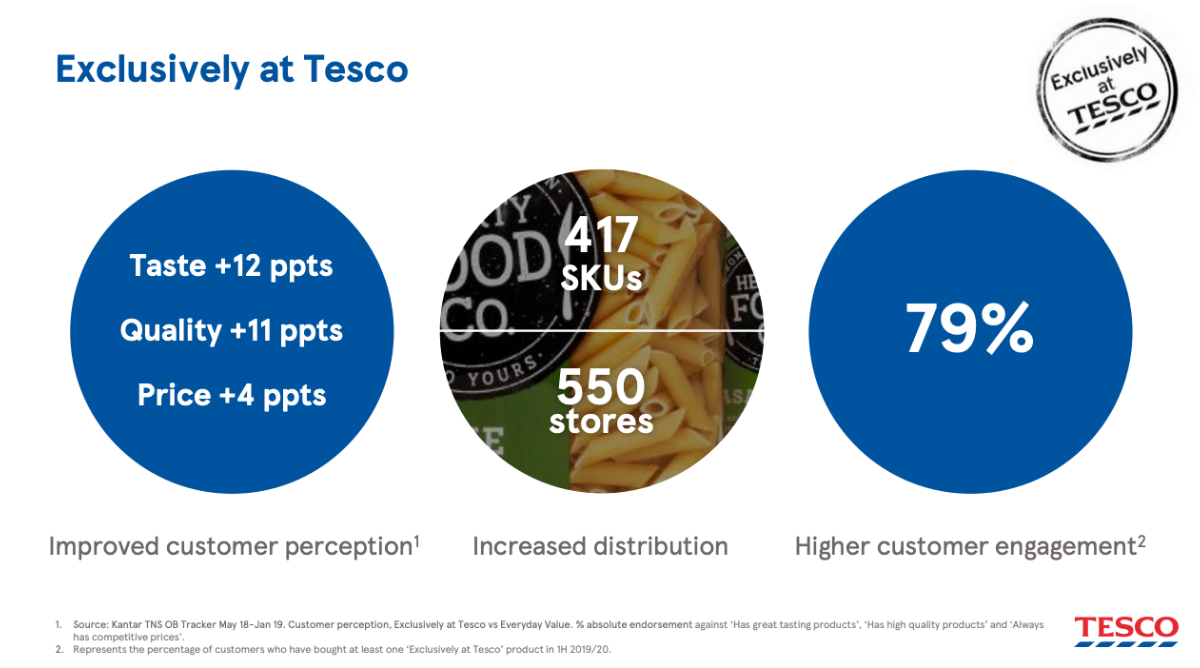
Quality speaks for itself in terms of the exclusively at Tesco tier, a big improvement in perception, value and the more stores, getting more of the products helps the volume number.
The brand had taken a battering for a number of years, big bad Tesco opening stores wherever and generally being viewed as a poor neighbour. To be fair to Philip Clarke, he did realise this and the investments into stores were aimed at improving things in this regard alongside the many other elements.
The horse 'beef' issues saw Tesco on the front foot, apologising and making their way to improve the brands. Unfortunately, there were further issues and then the stores fell over and it all went a bit wrong for the business.
It wasn't sustainable. Showing a few stores with nice refits but then seeing that the wider world hadn't changed and things declined rapidly.
The improvement in brand health has been a common thread throughout Dave Lewis tenure, understated campaigns like "Food Love Stories" have been a common theme and the work around value, own label, charitable work etc have all helped.
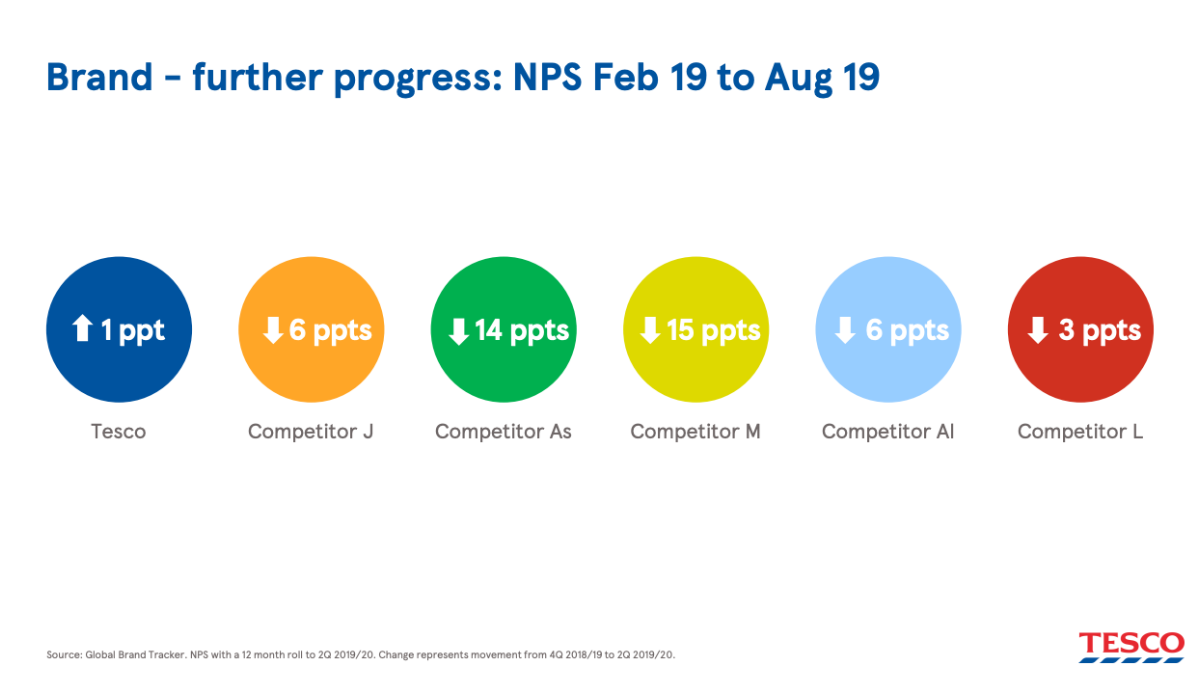
The chart at the half-year showed that the brand has improved and continues to do so in the past 6 months to August 19. Sainsbury's fell 6 points, the merger being abandoned perhaps helped this score but Asda and Morrisons falling so strongly was also intriguing.
It's never clear why this is but it points to a concerning trend for both businesses and not entirely clear why that would be. However, the net promoter score is just one element of research and sourcing,
From the Grocery Insight newsletter archive, first sent to subscribers on 22 October 2019. Steve now writes at read.groceryinsight.com. See also the blog archive and briefings.