Discount category killers - 1) Household
22 May 2017
I do like Target as a retailer; and must write up my thoughts on their central location in NY (Tribeca, just near the new Trade centre), and visits to the US always include Target who offer so much variety in their stores.
Wal-Mart offer lots too; often their stores can be a little more basic than Target, and busier... Whereas Target is broadly easier to shop, although they can be 'seen one, seen them all' in terms of their layouts.
Tellingly we never really visit the GM sections in Target (mainly as we have to fly it all back) but also, the prices are often prohibitive.... Whereas Wal-Mart don't have that issue... You'd never go for Pool toys to Target really, it'd be Wal-Mart.
The incoming threat from Lidl US and their push on all things discount will be intriguing, plus efforts from Aldi US to try and get involved in things despite being over in the US for years and targeting 2000 stores by 2018... You'd barely know they were in the market...
There are numerous regional chains in the States; alongside those that operate under several banners but are owned by one company (IE Ahold/Delhaize or Kroger), these are all under threat from the incoming Lidl surge.
But what about the coast to coast operators? Wal-Mart you have to feel will be ok as they're renowned for low prices and wouldn't allow anyone to impose lower prices on customers. Plus their larger outlets and big box mentality would entice a different type of customer to the stores in any case you would think.
Not immune, but certainly resistant, and would react.
Target are another big box retailer but don't push low prices in the same way that Wal-Mart do. Target focus on a wide range of lines, with food which they're trying to push along with some success.
Their non food offer is strong and feels more refined than Wal-Mart, yet even as a tourist, they aren't as low in price as Wal-Mart are....
When you consider discounters and particularly Lidl - it is clear they will relentlessly push quality, price and the subsequent range limitation as a real positive around cost and price.
When you consider the Lidl 'category killers', you have to look at areas like Nappies and Household products like detergents as seemingly obvious areas for Lidl to really hone in on their different model and how it translates to being better for customers.
If they can also rapidly get across W5 (their own tier detergent for example) is equivalent to Tide, be it via their own taste tests or even just as a basic comparative, albeit far, far cheaper... Then they'll start to get a foothold in the market in the States they exist within.
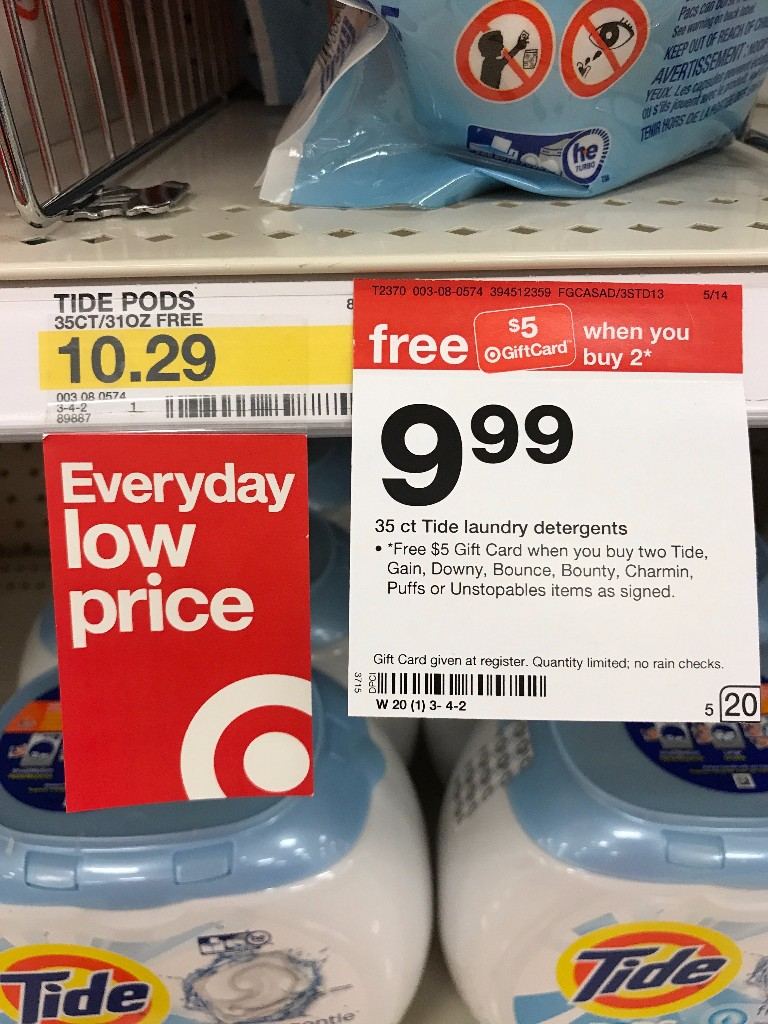
This confusion at the shelf edge will be seized upon by Lidl, whilst their relative success won't be replicated in the same way as the UK, due to a preference for a lower price model in the States, plus the sheer size of the country.... It's not great.
$9.99 for Tide in Target, but the shelf edge shows $10.29 as an everyday low price. But the larger label shows them at $9.99 each with a $5 gift card when a customer buys two.
Why not just invest the gift card into lower prices overall?
All that needs - and it's a problem for Target and the big FMCG companies to deal with, is an equivalence test by Lidl and the result flagged in store - alongside the subsequent price differential that we know will exist.....
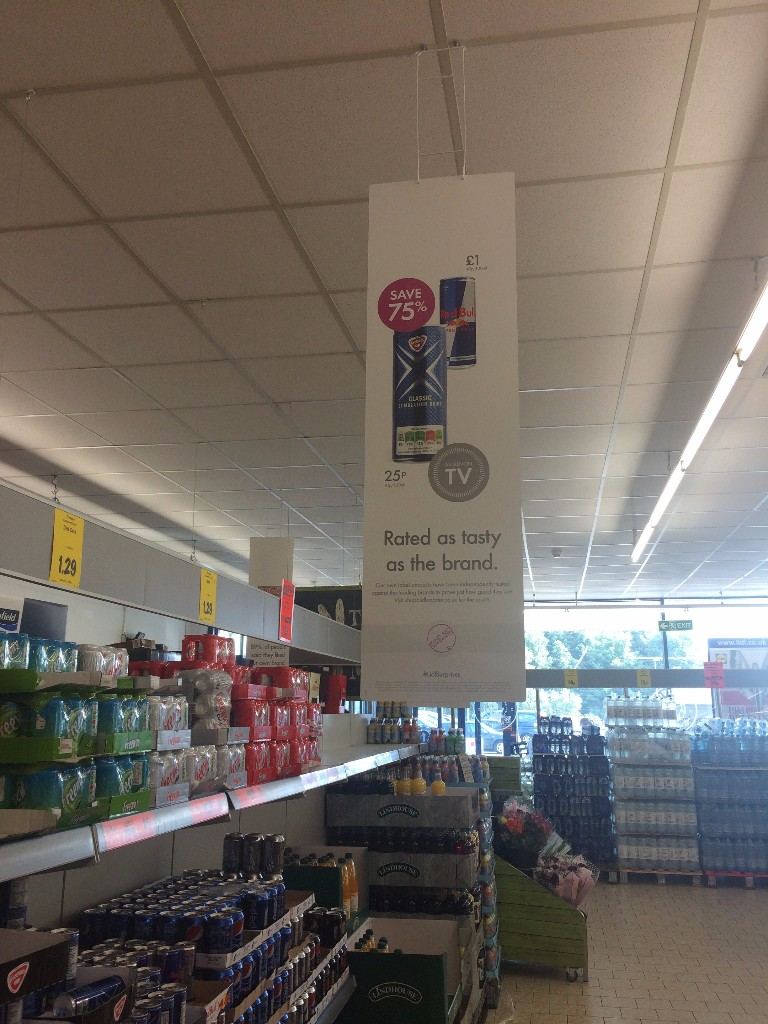
Like this! Very powerful messaging.
Lidl brand was rated as tasty as the brand (Red Bull) with a huge 75% lower price charged for the Lidl own label, an advert from around 2014/15 in the UK Lidl stores.
It also shows that the battles are not just for the US retailers to fight in isolation, it's also down to the FMCG manufacturers to protect their brands too.
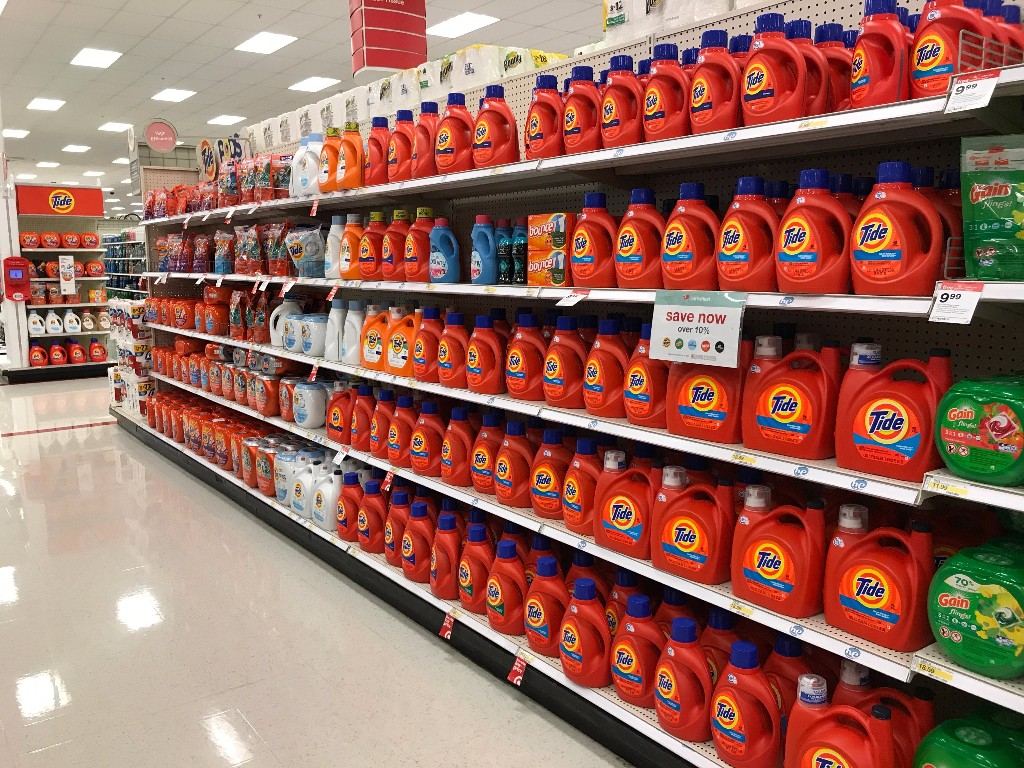
Choice is another factor that will be tilted by Lidl; they'll hammer home the message to customers that they themselves are in fact paying for all this choice.
There is a huge range of Tide (just one brand in this image near enough), but it's America, a different market, I do understand.
However; it's relatively easy for Lidl to paint this positively for themselves.
An example:
Their brand rated as comparative with Tide
Tide price at Target - $10.
Lidl price for own brand - $4
Simple.
This is without Lidl considering comparing themselves on easily transferrable food items - like Produce. Or indeed anything else around the store.
The one way to defend against this; is to push own label and ensure the 'price war' remains firmly stuck with own label and away from any unhelpful branded comparatives where the price differential can be significant.
Own label vs. own label = a 'let's play fair' message. 'We don't compare branded items with own label, so why should others' - alongside price matching / beating on these own label lines would be powerful.
Could easily be adopted as a state to state model as/when Lidl launched stores.
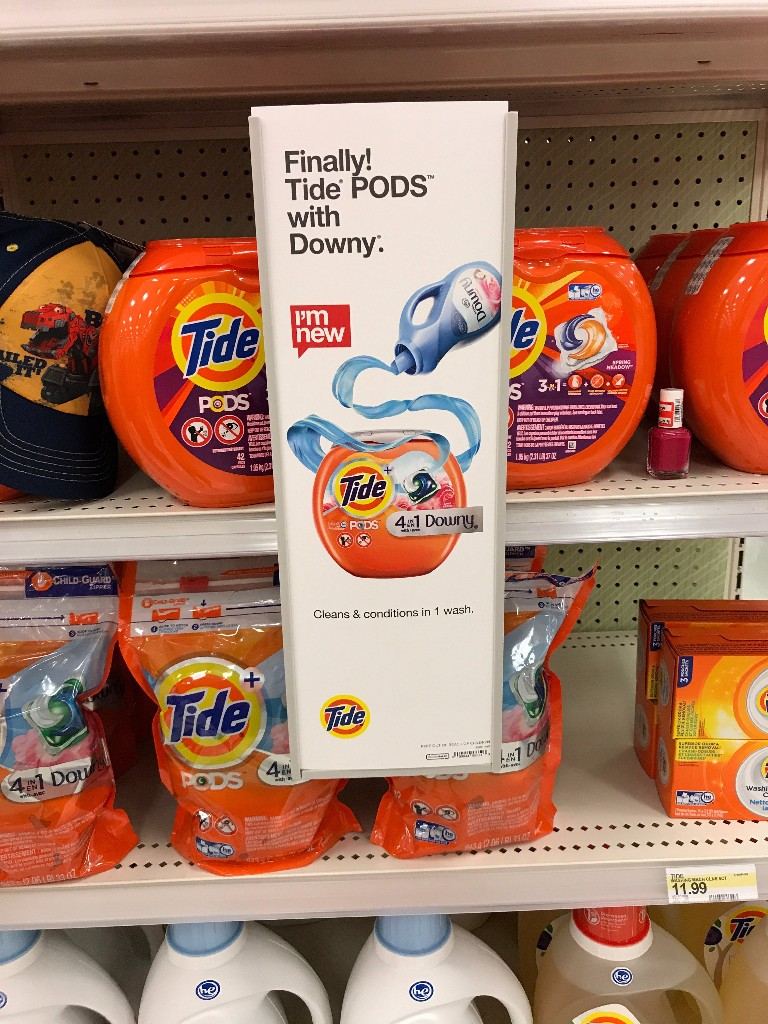
Even more range!
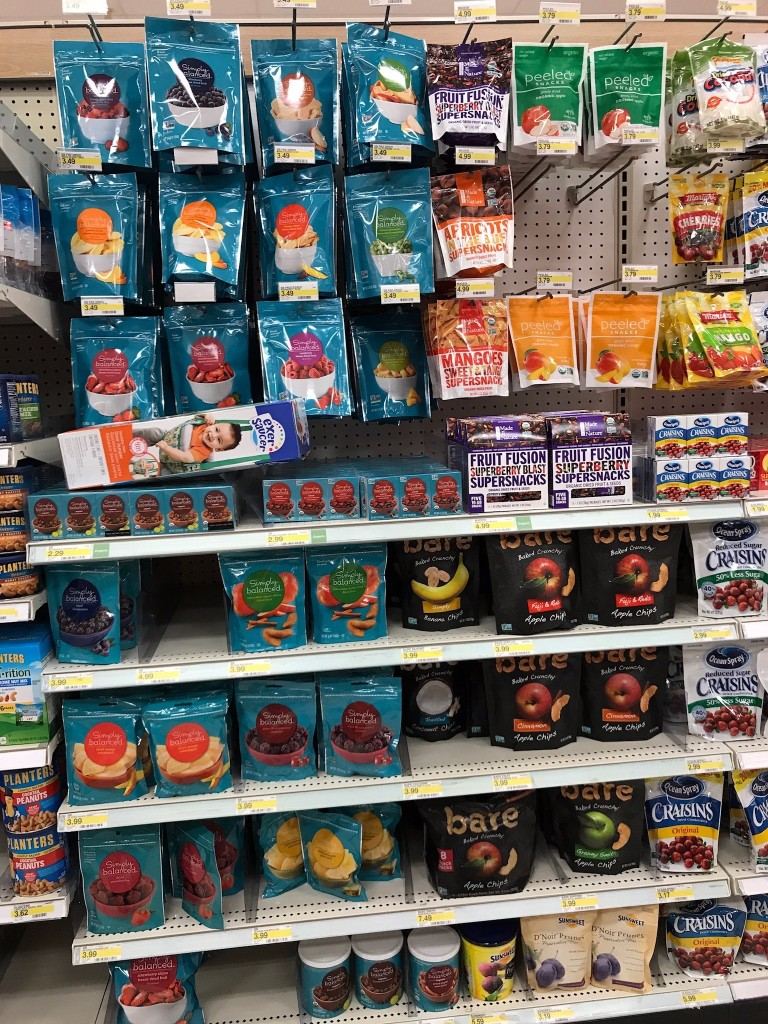
Controlling the discounter surge from Lidl / Aldi will require a concerted effort on own label, Wal-Mart have already spoken about a need to enhance their own label proposition to differentiate and provide value alongside the brands.
So much of this comes down to price and quality, naturally. But crucially it's about where the products sit on the shelf and also in the bay in the aisle that's an important factor.
The customers will ultimately buy recognised packaging that looks the part for a product that's merchandised well on shelf, in a convenient location.
No one wants to be reaching down to the bottom shelf, nor up at the top either.....
Branding the own label right is crucial, look how much effort large companies spend on marketing their own products..... But for retailers to push back effectively over the longer term against discount, it's all about the own label and the exposure in which that range gets on shelf.
If we consider the above; Target appear to drop their own label in blocks which isn't necessarily the best method. Blocking means the range is put together in one column and if that bay is too far up / down the aisle, it could be missed by customers.
Whereas putting the own label front and centre, works as the customer can look at the branded offer, then find the own label alternatives appropriately dropped in alongside / near the brands which means that a lower price can attract the customer in to this range.
It also means that there doesn't need to be a multi million dollar investment in price, sometimes it can be just about siting the own label.lower in price, at a more suitable location on shelf to give an overall perception of lower prices, or at least level prices.
Not just bays upon bays of higher priced branded products.
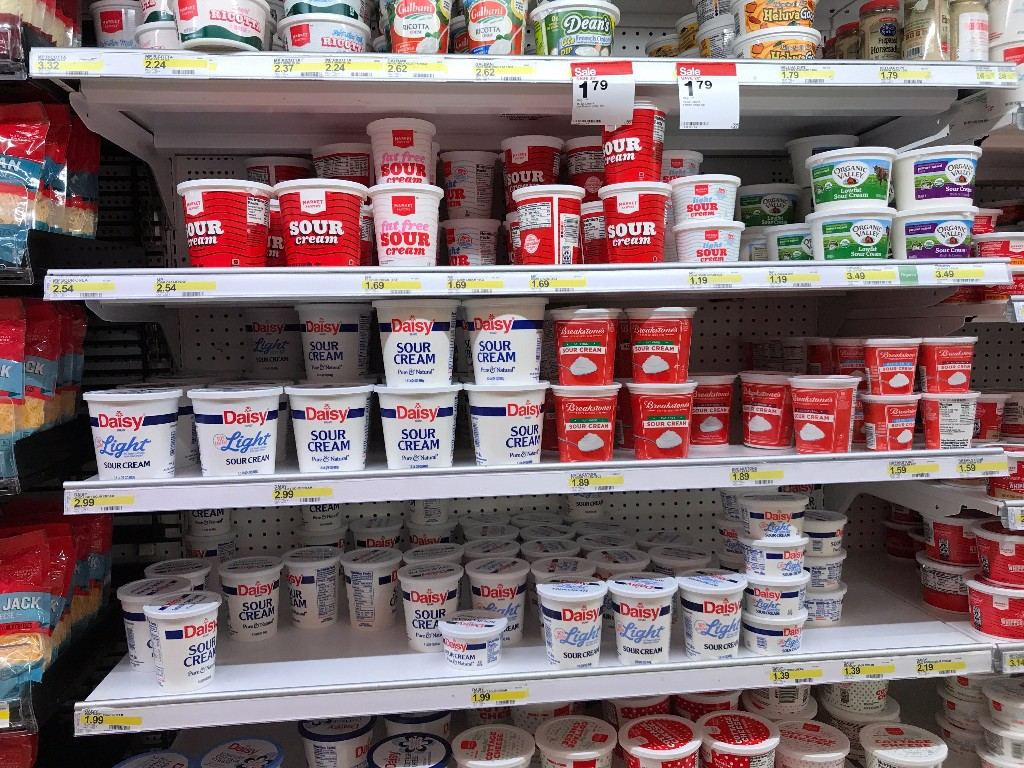
Here's an example of a lot of choice in Cream, different mentality to the UK customer in the US so understandable.
Own label is striking in Red, on the shelf above with the brand just below, alongside another brand, also in Red.
Daisy brand sits below that shelf too, with the own label near the top of this fixture, some 6 products - both light and full fat options.
The location in fixture isn't bad, eye level (ish) but interspersing all of it together isn't necessarily the best option, ideally it would be a solid shelf with full fat / light options together. It's rather overshadowed by the brand below....
Where's the value? It's not easy to see here, although the own label does favour quite well on price versus the branded lines.
So, Lidl will have many in their sights and coast to coast retailers are ones that will feel some impact but their sheer size and scale versus Lidl (3 state ambition initially) means they should be able to navigate reasonably well, with some adjustments.
More on the discounter category killers this week, as we focused upon Household today alongside some wider merch/fixture issues too.
Next up we have a category that discounters have done ever so well with, Baby, and more specifically. Nappies.
For any further service offerings around discounters, strategies to consider and what has / hasn't worked so well from other markets. Please don't hesitate to get in touch, we have several thousand in store images from discounters and examples of their execution and different campaigns from the years gone by.
From the Grocery Insight newsletter archive, first sent to subscribers on 22 May 2017. Steve now writes at read.groceryinsight.com. See also the blog archive and briefings.