Tesco / Booker - High level overview (30 January 2017)
30 January 2017
Subscribe to this service here.
The deals to expand a retailer by taking over another, or indeed launching joint ventures as Sainsbury's did with Netto in 2015 always catch us by surprise.
Of course, the secretive nature of any deal means that we're all in the dark until it's announced, and Friday AM was chosen as the time for Tesco to announce (a mere 18 months into their recovery) that they are to 'merge' with Booker.
Now merging is perhaps a kind word for the deal, and I can see the point Tesco are making. They want to retain the trading name and the outlets that Booker have (in the main presumably) and don't want to steamroller into a sector and plaster their name everywhere.
But it's a takeover for the trading goodwill and know how of the business, and the sites too. It's not a merger, given that Booker once the deal is done form a mere 16% of the wider business...
In addition, it looks a way to capture Charles 'Two brains' Wilson from Booker and integrate him into the Tesco world too, seemingly he usurps Matt Davies (UK and Ireland CEO of course) to look after Booker and perhaps also become deputy CEO, or even Chief ops officer of the wider business.
A great hire, and retaining him alongside the chairman means Booker should run even more effectively given the areas in which Booker excel like Fresh Foods given their catering supply base, Tesco have challenges of their own.
Similarly Booker have issues of their own, legacy system for the membership details, deliveries and logistics of the Chef Direct order have proved problematic to say the least.
Given food retailers run online / wider supermarkets at some 96+%, Booker fulfiling orders at 74.9% availability (down -0.8% on the previous period) shows where the Tesco expertise is sorely required.
On the face of it, you would argue that it makes sense for both Tesco and Booker to join forces. This is before we consider the scale in which the enlarged group will operate at, the main question is whether Tesco are ready for it.
Dave Lewis loves the virtuous circle in own label and whatever you may think about his decisions, at least he has been decisive. Nothing worse than a CEO who flip flops around month to month, firing about 50 starter pistols on campaigns in desperation to get anything to 'stick' and bring sales in.
Lewis has correctly targeted discount, and also the Tesco own label in an effort to combat the Germans who had it easy for too many years in the UK.
By focusing on own label, you immediately take back all control given the exclusive nature of the label to Tesco. All sounds obvious but think back to what Tesco were like under Philip Clarke.....
Better planograms and availability, alongside price investment drives Increased volumes drives further buying efficiencies which in turn lowers the base price to a customer.
By putting Tesco own label at the forefront of the customers mind, quite literally in fixture. It means that Tesco can start being different, focusing on quality and value without necessarily banging on and on about price.
Bringing Booker on board means the Tesco products can get out to a wider world, via the professional food service operators and also into those independents via the franchise operation.
Thus bringing us nicely to the 'slides that matter' from both the Tesco / Booker merger document, and also the last set of Booker results (half year - September 2016).
Whilst the legal firm Freshfields may indicate, that in law, technically Booker has no convenience stores as they only supply the stores. The reality is that the CMA will take a different view given the control of supply that would be afforded to the enlarged group.
By definition, that extends to the convenience market in general, Tesco perhaps spurred on by the success of the One Stop franchise model clearly want to expand this significantly. However to do so at scale is virtually impossible in a mature, saturated market like convenience.
So buying up Booker makes sense, however the CMA will surely look at the control element of the market here. Tesco are a huge player in convenience in any case, without One Stop and then without a huge franchised operation via Booker too.
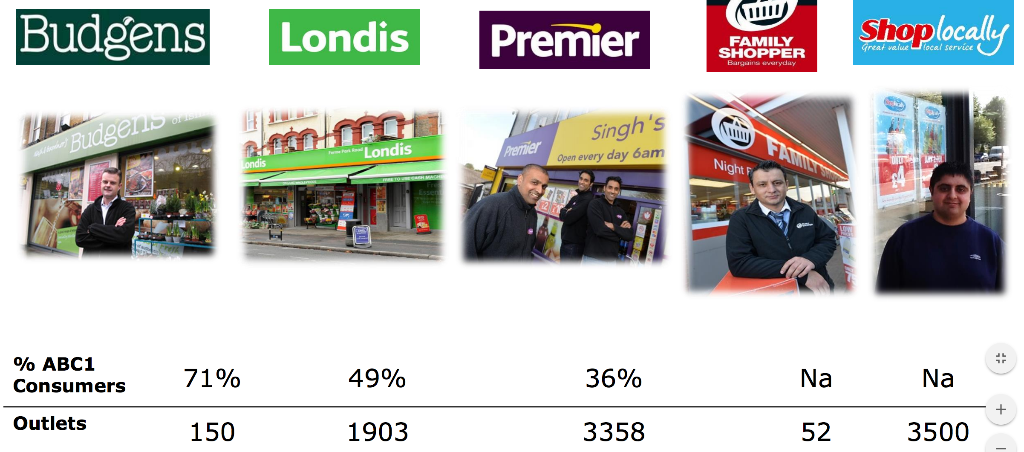
Considering the slide above; the bulk of the estate comes with only 36% of ABC1 consumers. Premier broadly serving 64% of customers for whom life may well be a struggle.
No news on 'Shop Locally' / Family Shopper 'affluence %' but again, a huge number of stores trading under this banner - described as a mix between hard discount and a regular supermarket by Charles Wilson when it launched.
The bulk of their franchised estate sits at the value end of the market which is a difficult ask to grow own label sales. The bulk of these stores will be CTN in the main (Confec, Tobacco, News) and off licenses. Stocking the essential grocery items and some fresh foods.
It will be interesting to see what Tesco could bring to this environment - Fresh Foods / Farm brands perhaps? Or even more Aldi based brands to take on discounters in another channel?
The wider Budgens and Londis chain look attractive and some of these stores are smaller supermarkets in their own right. Good focus on local lines and an affluent customer base too, lots of Tesco assistance here would be ideal for the franchisees.
However the crux of the issue with the CMA will be the sheer number of locations supplied, and this will likely be a factor for the independents supplied by Booker as things stand.
Essentially they will all be supplied by the Tesco group, fighting against the local Tesco Express but stocking products sold by the same wider parent group. At different prices.
It could open up value perception issues with customers who hear that Booker is part of the wider Tesco family. 'This is 10p cheaper at Tesco, it's all same company now' etc etc.
Customers are famously literal in many respects and will assume any dual banner is designed to 'rip me off'. See the fury that One Stop used to get for being owned by Tesco but not called 'Tesco'.
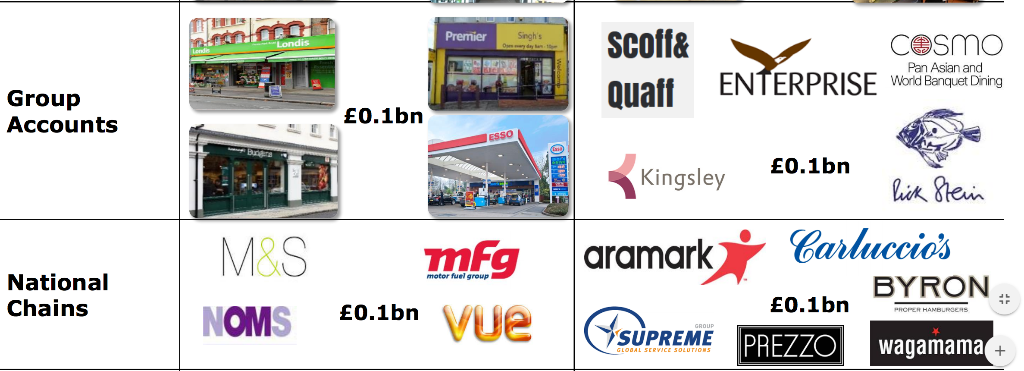
Professional food service brings some excitement to the table for Tesco who seemingly see a chance to enhance their marketing and understanding by being part of a chain that supplies the likes of Prezzo.
It's a good way to drive some innovation in stores; as noted by Tesco - fresh food kitchens in larger Extra stores, interspersing the 'Chef's Larder' range to 'eat out at home' etc.
Similarly the Booker stores have a Butcher who could potentially supply his wares into the local Tesco store - 'supplied by Booker / Chef Direct' etc. Would allow a cost saving for Tesco and brand enhancement for Booker too.
All looks very common sense in this regard, attracting 'business professional' customers to Tesco seems to be an important play for space optimisation too.
Extra stores come with lots of space, lots of back area space and huge car parks. No reason why click / collect couldn't be optimised for larger vehicles to pick up their orders as necessary.
Noteworthy that the wider Rick Stein / Carluccio's business is only £200m of the wider Booker catering business. Whilst important to attract these brands - it's not a huge part of the business.
The major money is in the franchised operators who buy via Booker and a significant number of small catering operators. Whilst there has been growth in Chef Direct with Wagamama et al, it's proportionally small business based.
Longer term, there has to be one eye on who may exit any agreements based on the new merged company ownership.
M&S are supplied as things stand, would that change? Also noted are MFG who are running a small scale petrol trial with Morrisons. Quite the Tesco connection there with David Potts at Morrisons and Richard Baker CEO of MFG.
Pick and Mix and Hot Dog prices should come down in Tesco given the volume they acquire with Booker supplying Vue Cinemas who operate a hefty price premium to say the least.......
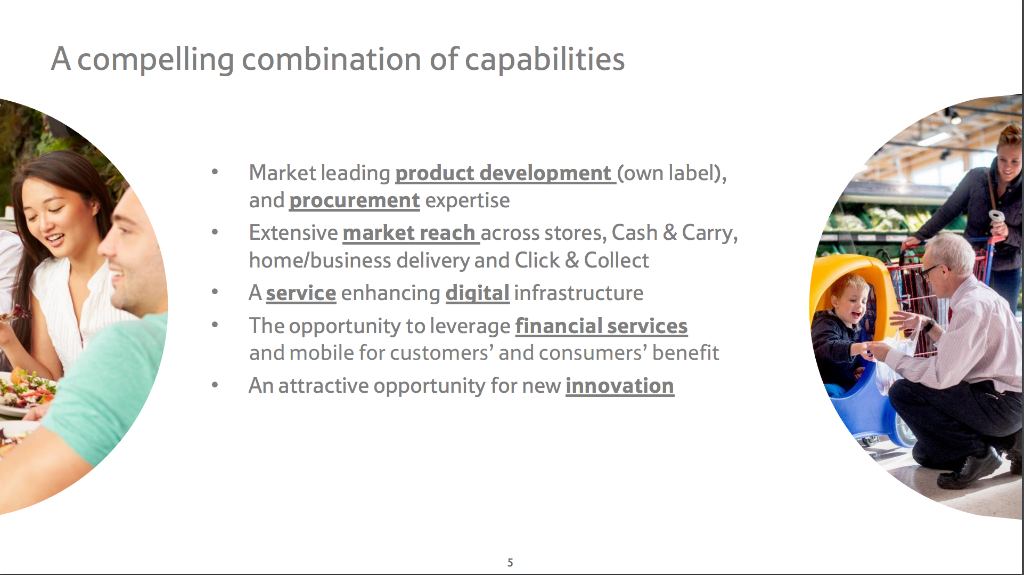
Digital infrastructure will be aided by Tesco; their online pick operation is unrivalled and they have sorted logistics out for their businesses across the world.
There is also Clubcard of course, where Tesco are able to bring a whole new level to customer analytics and sell across the chains. Linking with that is the Tesco bank angle, lots of opportunity around finance for the smaller businesses here.
Similarly utilising their payment merchant 'PayQwiq' that has just been rolled out to all Tesco stores - controlling the way that customers pay alongside everything else is very noteworthy.
The big aim is to cross sell; that halo effect from a business customer heading into Tesco to complete their own, personal shopping, or even adding non food to their basket which would aid that margin / profits target.
If Tesco are able to add a cash/carry offer to their larger stores, then this would drive footfall and open up numerous opportunities for the chain.
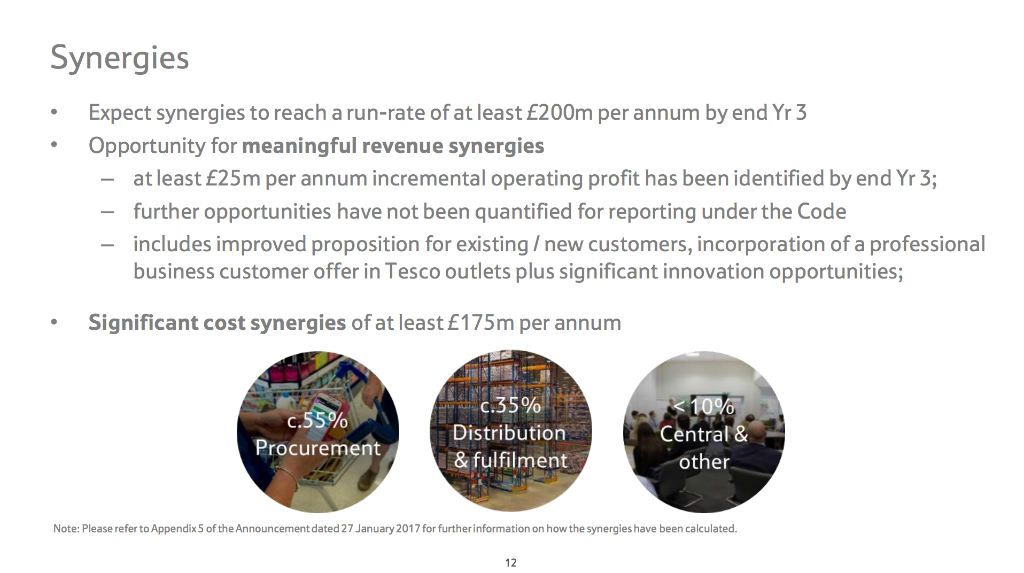
In terms of the all important (£) to stack up the deal. £25m profit increase by Year 3 which would be likely post rationalisation of distribution and central office costs.
Booker have a depot in Livingston serving Scotland and the North, however Tesco also operate a DC in Livingston - something has to give there.
Noteworthy that further opportunities have been identified but not quantified, presumably click / collect alongside online orders placed in Tesco stores and fulfilled by Booker as appropriate?
The improved proposition is intriguing, Booker currently operate a membership scheme but it's free for customers, providing you're a business or a charity.
However Costco open up their scheme to non businesses, providing you're a professional person (Police etc) and pay the relevant fees to join. Everyone joining Costco pays and this represents pure profit for the chain.
Could Tesco launch something similar to Costco / Amazon Prime even? Linking Food / Bank / Non Food / Direct / Clothing / Booker with free deliveries included / discounted?
Booker will look to enhance their same day delivery (trailing in Norwich) through Tesco and again, this would be a point of difference for a membership scheme.
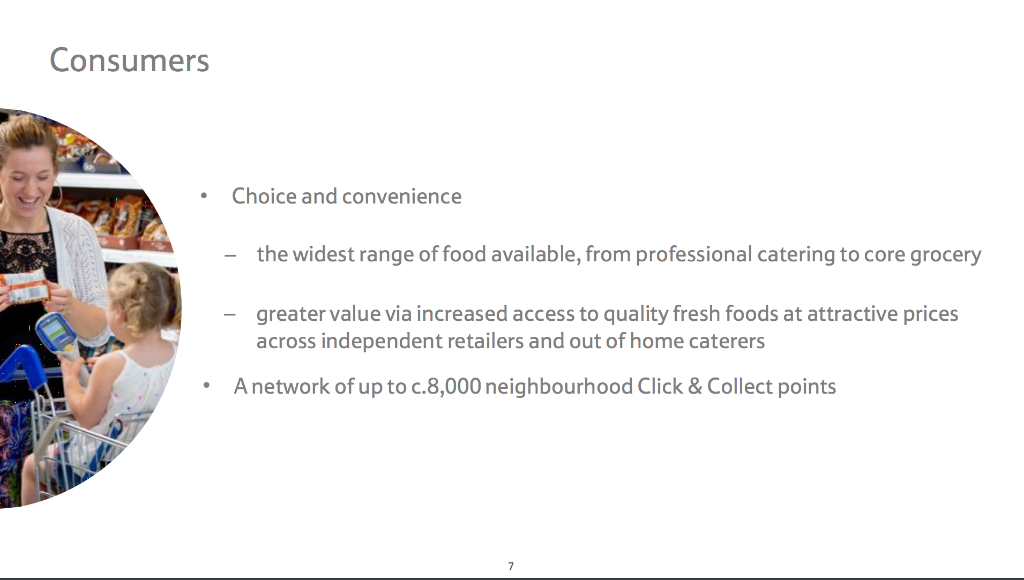
Click and Collect has been tried by Tesco, Philip Clarke pushed it incessantly, but the market has moved on. The UK brought consumers up on low cost deliveries, ever improving time slots and money back if the van was late.
Why would anyone therefore opt to collect? There are some who don't want to wait in of course, but with hourly slots and passes offering lower cost delivers for regular users - why bother?
Businesses are different in that they don't always have time to be around for a delivery, and may opt to spend time working in the business rather than wandering around a cash/carry warehouse. So a delivery service, same day / short notice could work.
Given the relatively poor metrics that Booker have thus far, Tesco can being demonstrable improvements to deliveries, before the vast number of click/collect sites are considered.
In addition, the non food business for core customers could improve too. A significant rise in the number of neighbourhood locations to pick up parcels enhances the convenience offer.
The Fresh foods angle is notable, Tesco have made a lot of progress in food but have a long way to go. Owning a professional supply company can only aid the perception and give way to range innovation and marketing opportunities.
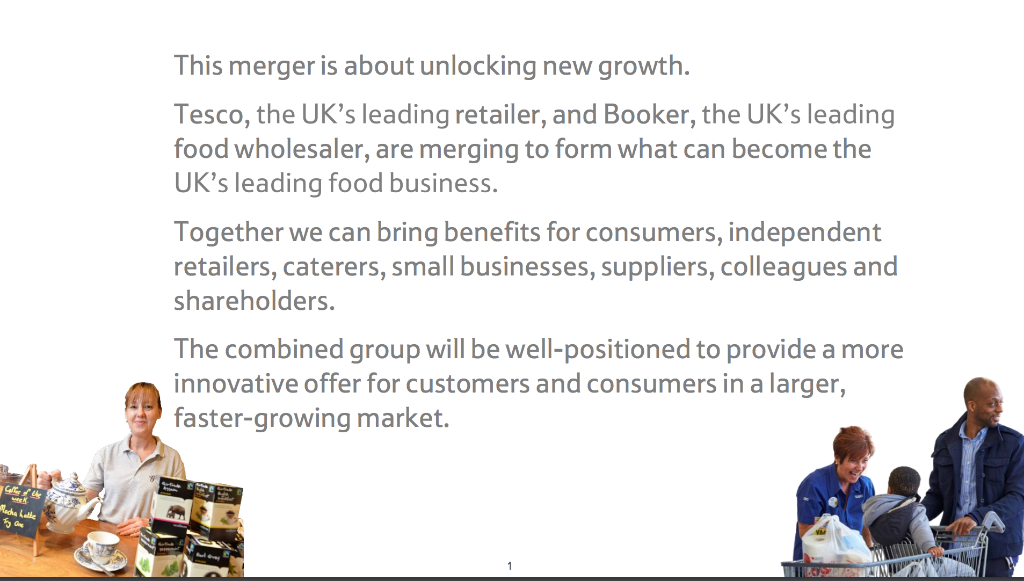
Where the deal will clearly bring benefits for Tesco in terms of food provenance and further volume to lower prices, along with Booker benefitting from a world class insight, ordering and delivery partner for their business alongside further volume to boost the business.
The key aspect to the deal is 'unlocking new growth'. Franchising is the new convenience / online in the food retail space.
Growth is limited in a market where space is abundant, margins have been stripped by discounters and the 'easy money' of non food and larger stores has gone.
Therefore franchising is the new golden goose, it's not a concept in the UK that we're entirely comfortable with - bar Tesco with One Stop and even then, it was just operated under a different name.
The recent moves for One Stop to operate a franchised offer (c.100+ stores), Morrisons to operate Safeway branded petrol station / c-stores and Sainsbury's local partnering with Euro Garages to have them operate the forecourt shop shows that this model does have legs.
All eyes on the Co-Operative who don't have a franchised based operation yet, however they will have been watching the moves with interest.
There could well be a few disaffected independents within the Booker fascias post this deal being announced....
All eyes on the subsequent CMA investigation!
From the Grocery Insight newsletter archive, first sent to subscribers on 30 January 2017. Steve now writes at read.groceryinsight.com. See also the blog archive and briefings.