Sainsbury's - Noteworthy slides
3 May 2017
Noteworthy points from the results / slide presentation to the City by Sainsbury's today:
A big year for the chain and their expansion with Argos is to be completed ahead of time by 6 months.
59 Argos stores have been dropped in to Sainsbury's stores so far; with like for likes up 20/30%, with the Sainsbury's store benefitting from a 1-2% uplift too. Their target of 250 by 2019 has been brought forward by six months, along with the cost saving too.
60 existing high street Argos will be converted to the digital format, it's intriguing to see where these are, but also how (if at all) they link with Sainsbury's.
There are some 200+ collection points in store (iPad unit near the customer service desk) but only 90 offer Argos collections alongside DPD and eBay. Unclear why only 90 do this?
Not a great deal on Habitat other than the 7 small stores to support their strategy, no colour on the standalone in the ex Netto near Sainsbury's in Leeds either.
Bank and associated Argos financial services seem to be progressing well, with various IT projects pulling these together, with Nectar this will enhance their insight and enable more targeting of customers.
Unsurprising that both GM and Clothing were positive, both have performed well and had a significant level of investment and support in stores. Ranges are exciting and the events are often very strong.
For Food, the news was less positive. A like for like dip of 2% despite inflation appearing at the year end. Their quarter four performance missed Easter, Red Nose Day and Mother's day which will be seen in Q1 (which is a long old period) and encompasses some busy trading events.
Expecting big work on own label this year as they aim to touch products that contribute 60% to their overall food sales, so all eyes on what they do with these ranges. They have done work on 3000 products so far, but there's very little around the stores to support this.
Abandoning the meal deal in good to go looks to have paid off as their wider range looks stronger as a result. Similarly Free From gets a good write up and justifiably so.
Prep veg was an example of strong work; Courgetti and Boodles et al. They have innovated ahead of the market here, so fair play and they deserve their double digit growth in this area. More needed.
Notes on colleagues raising money and also that they retain paid breaks, a subtle dig at those retailers who have adjusted their wage packages ahead of the living wages, losing paid breaks and other perks on the way....
Convenience is in growth and still performs well, admirably so. They deliver a consistent shopping experience in convenience from my experience, so credit here. Their franchise partnership with Euro Garages appears to be working well as they're up to 7 stores now.
Online grows too; click / collect groceries is at 151 sites and they appear to be not leapfrogging the market by following efficient tech, rather experimenting with numerous methods.
A store in Leeds has a driver sat in his van awaiting customers (expensive) whereas another store near Liverpool has a button to press as you park up, allowing the store to bring the shopping to the customer. For non food, you have to go inside...
Lots of work to do in this area, especially in terms of finessing the overall approach and interlinking non food and food, and Argos.
Cost savings of £500m will be achieved by the end of this financial year, with another £500m then targeted for the next three years after this.
Their new pricing strategy is pointed to as contributing to the savings, with less choice, brands removed that are just for deals thus a simpler operating model.
Technology is expected to play a part with the next batch of savings, and it will be interesting to see how they approach the changes, which they highlight as being within:
Checkouts being faster and more efficient. (hopefully none of those hopeless UFO style speed tills) although hybrids like Asda (where a colleague can serve, or a customer serves themselves) using a conventional till would be good. More work on mobile scan and scan as you go too?
Availability throughout the supply chain. Presumably more around just in time forecasting and driving benefits from a more stable promotional package.
More tech to eliminate complexity for colleagues and customers. Entirely unclear where, but there are often opportunities with tech improvements. Providing it works in real life of course, not just in the pilot store, non food / food click / collect looks entirely possible.
Electronic labels / signage could be included in the above; although the capital cost remains high here.
Simplifying offer around groceries where and when customers want them. Work with Argos around deliveries perhaps? Collection points / lockers at the Argos out of town stores that are retained? All options.
Underlying profit margin at 2.42% was a decline and work will be underway to recover this to a median 3% presumably.
Improved exposure to non food and clothing will aid this however the USD>GBP weakness must impact, food brings volume and transactions with it (Although transactions did increase).

To the slides, they've used the food dancing people around the slides which is nice.
Lots of focus on the future for JS and it feels a real future based outlook; which is appropriate..... Providing they don't then not consider the slowdown in food and undercook their plans there.
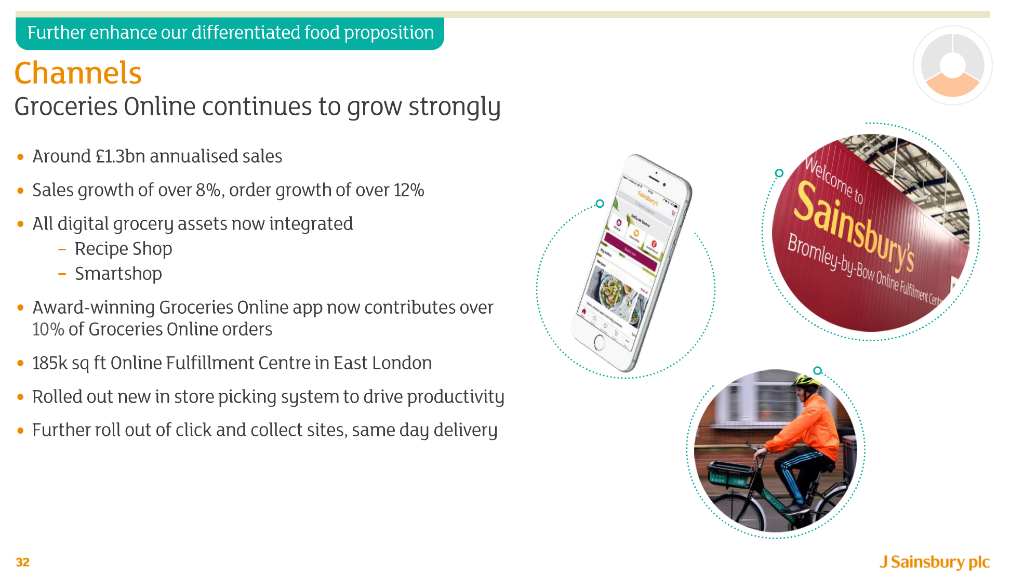
Groceries online is a positive for them, they do a good job here. Focus on same day delivery and a roll out of click/collect points feels right too, behind the curve in the market.
Dark store / centre in London is good and more of this is required where there are lots of orders and a good road network, would reduce costs too.
App works well too; 10% of orders via a mobile device.
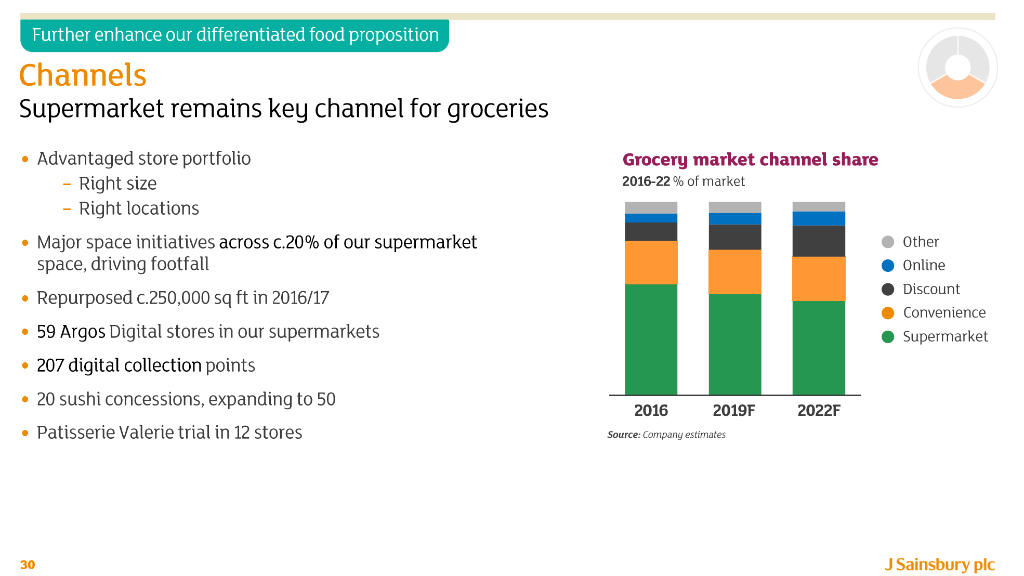
Sadly it isn't just online for those analysts who hate the stores, shops are still really important.
JS feel that they have the right sized stores and in the right locations. Some stores are still too big for me, which explains their concession plans for the future.
250,000 sq ft was repurposed which is a lot in reality, presumably Argos are included here. Sushi and Patisserie Valerie are also mentioned for the future.
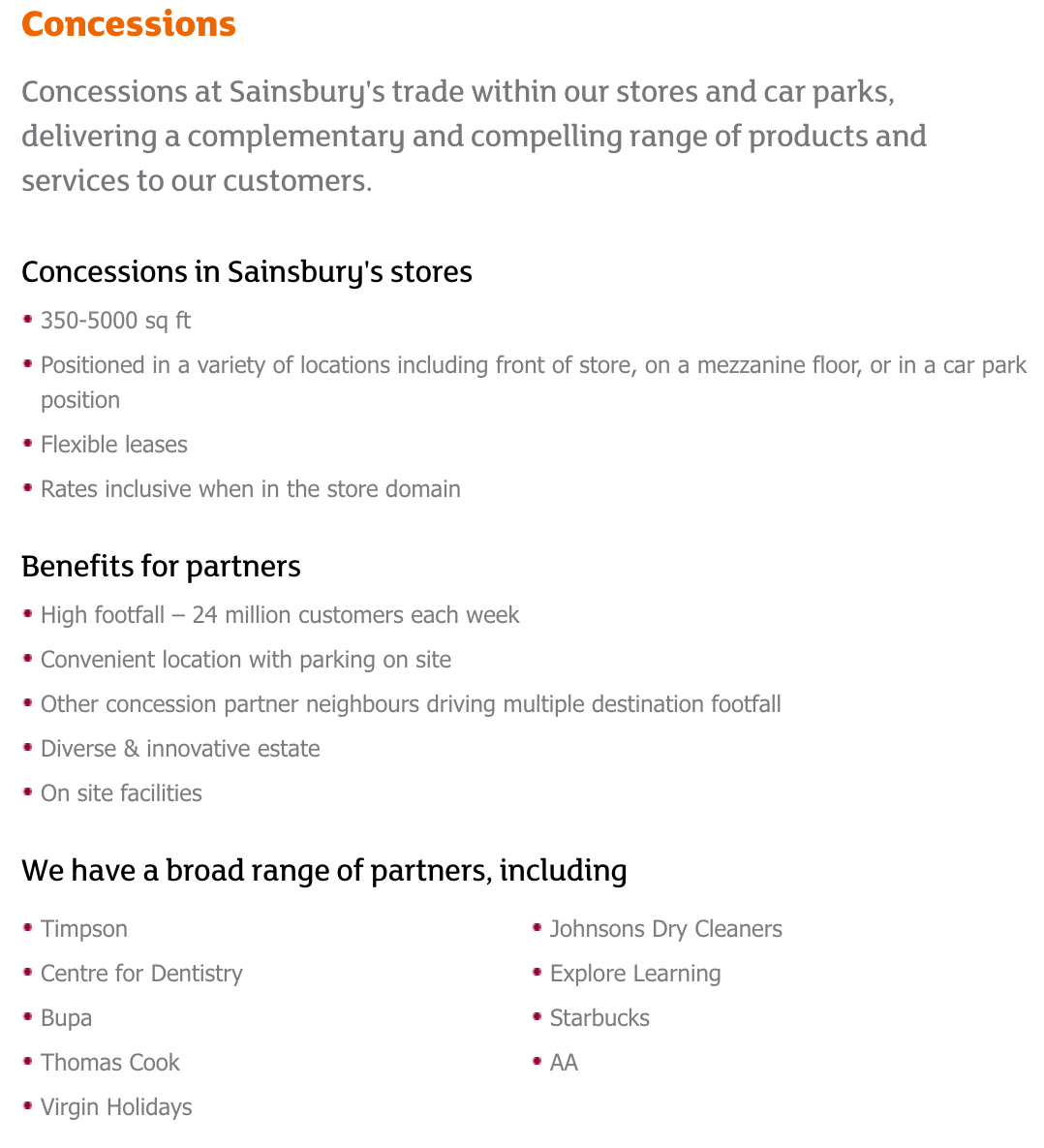
Interestingly, the Sainsbury's site has a section on concession partners, with interested parties asked to contact Sainsbury's property...
They flag they're interested in leisure, outdoor and baby retailers to take space....
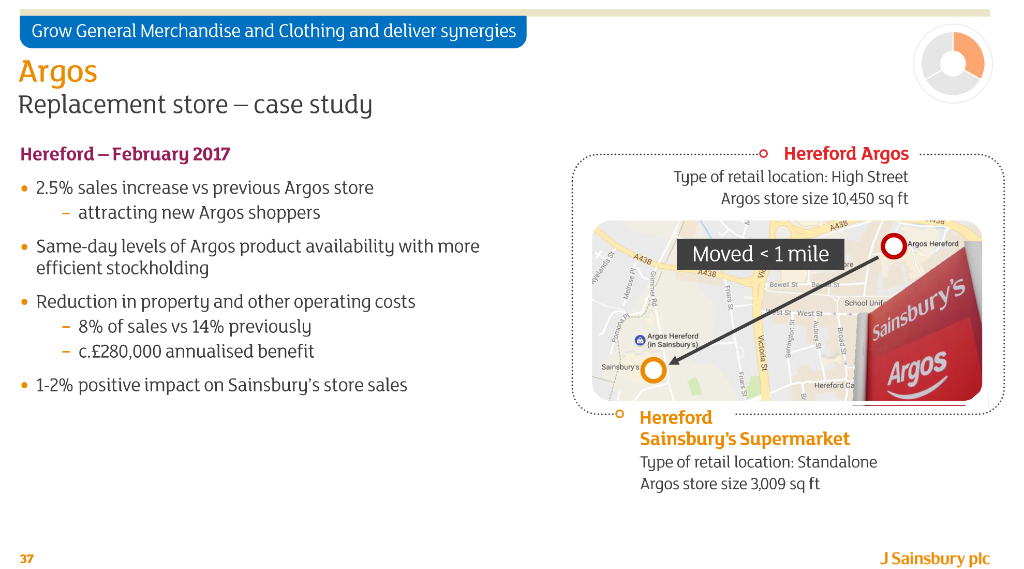
For property, lots of cost savings remain for JS/Argos where they close the existing Argos store, be it high street / retail park and push it into the nearby JS.
Brings down costs like rent and rates for the chain, increases footfall and sales for both JS and Argos in the new combined store and looks a winning strategy.
£280k benefit form just one unit here, with 1-2% uplift in Hereford store for this. Looks right for the wider business case.
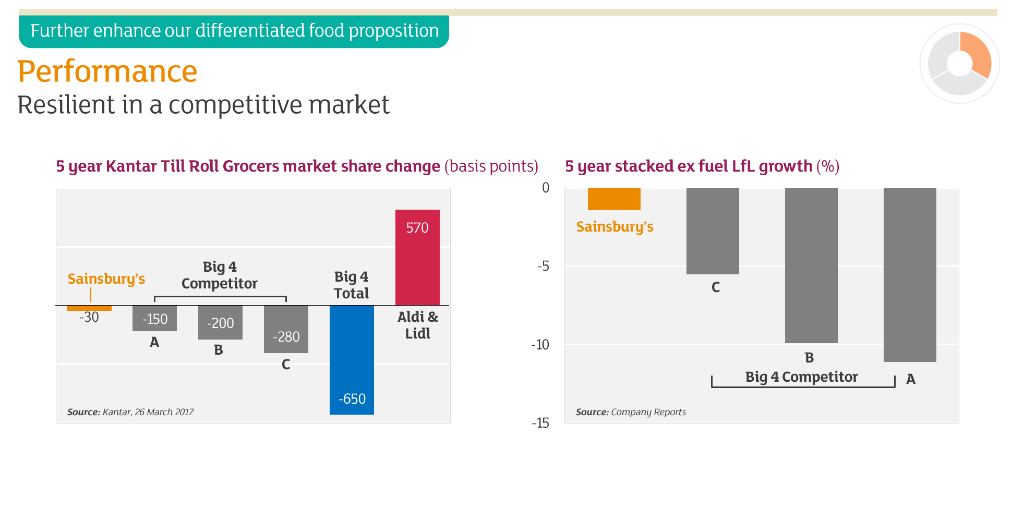
As I pointed out this morning, Sainsbury's never had that nadir of a c.-7 negative like for like number, and this 5 years stacked outlook shows this.
On average, their losses are negligible versus all 3 major competitors. I think A is Asda with that slide, B Morrisons and C is Tesco.
Similarly Kantar has them showing resilience in their figures with a 5 year historical outlook showing losses far lower at JS, good growth for discount though.
5 years is a long time.... If we looked at the past 3 years, how different would this be? Tesco would be the other way near enough, Morrisons too have been putting improvements together.
Fortunes under the new management at both Tesco and Morrisons would also look different versus Mike Coupe at Sainsbury's.....
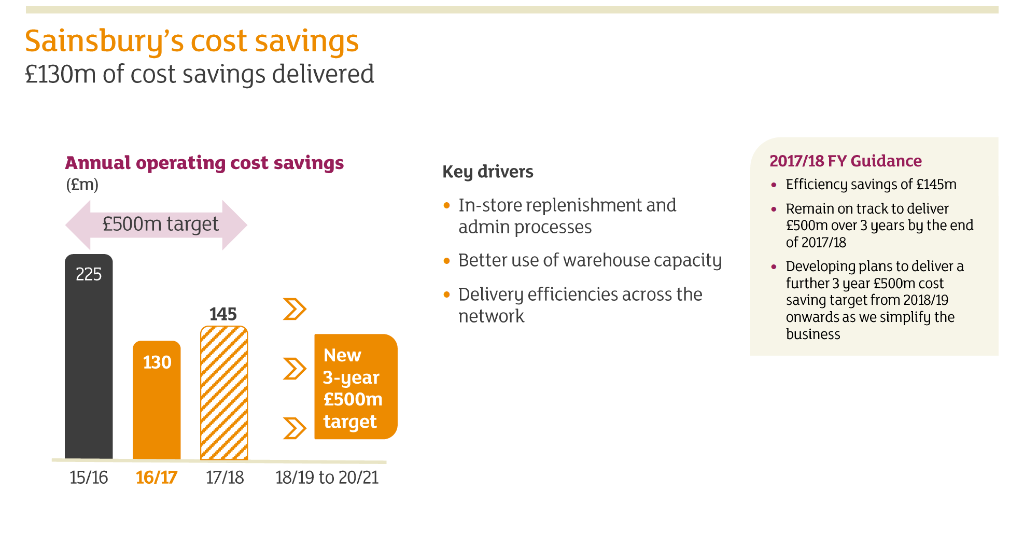
£500m more to save from combined businesses as the wider world is integrated, presumably a fair amount of savings will be IT based and allow Sainsbury's to run both Argos and Sainsbury's inside the same store far more efficiently.
More cuts and job losses are entirely possible too, especially centrally.
As outlined above, technology plays a part, but has to deliver the savings intended - not just on paper.
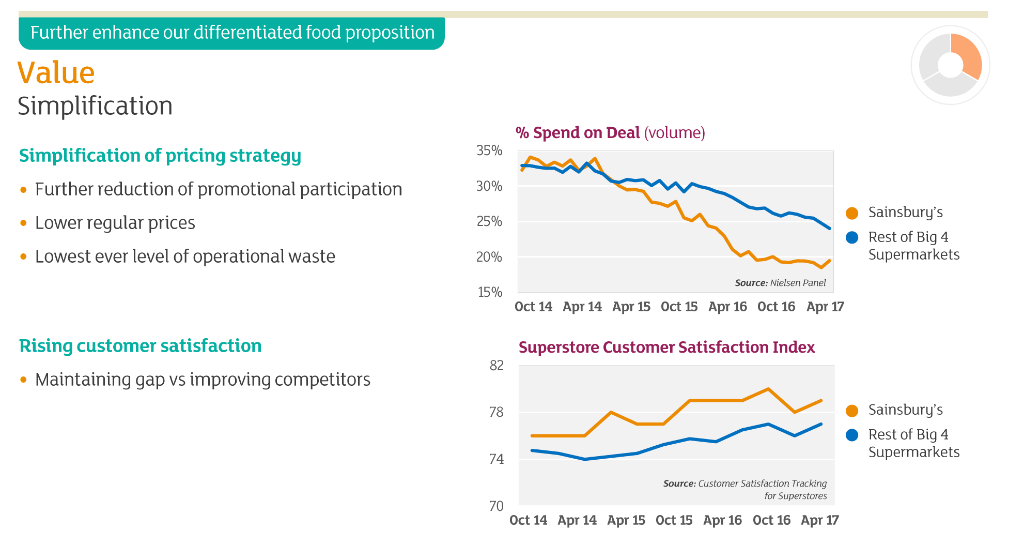
A nice slide here to finish the round up, looking at value and the simplification of which Sainsbury's have been very keen on.
Pulling away from more promotions (although as we've seen, stores and ends look overloaded in some cases with promotions). Regular prices are indeed lower as the volatility has moved from 'hi/lo' in many cases, especially on lines in household like laundry and dishwasher products.
Operational waste as its lowest level is purely down to less deals, promotions are so hard to forecast so anything that lessens the challenge for the systems on Fresh foods has a positive impact.
Spend on deal over the market is reducing but not as rapidly as at Sainsbury's. The customer satisfaction index appears to be point to increased satisfaction at superstores, not with value?
Or perhaps it is with value? It's not entirely clear.
Their strategy is their call and fair play to them for making such a decision, it does need refining at shelf edge for me. We have also seen promotional ends not looking sharp either.
The evangelical approach of no multibuys can leave you backed in to a corner a little... Especially when the others can pull the levers that you are unable to...
Finally.
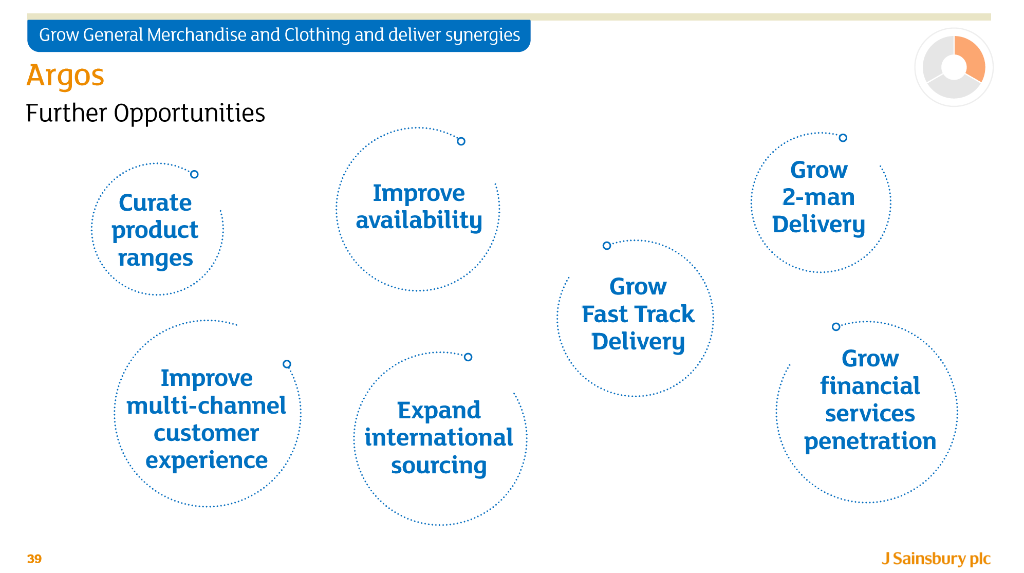
2 last slides, one shows the ambition for the business around international sourcing and multi channel experience for Argos. Availability and fast track are entwined and a real point of difference.
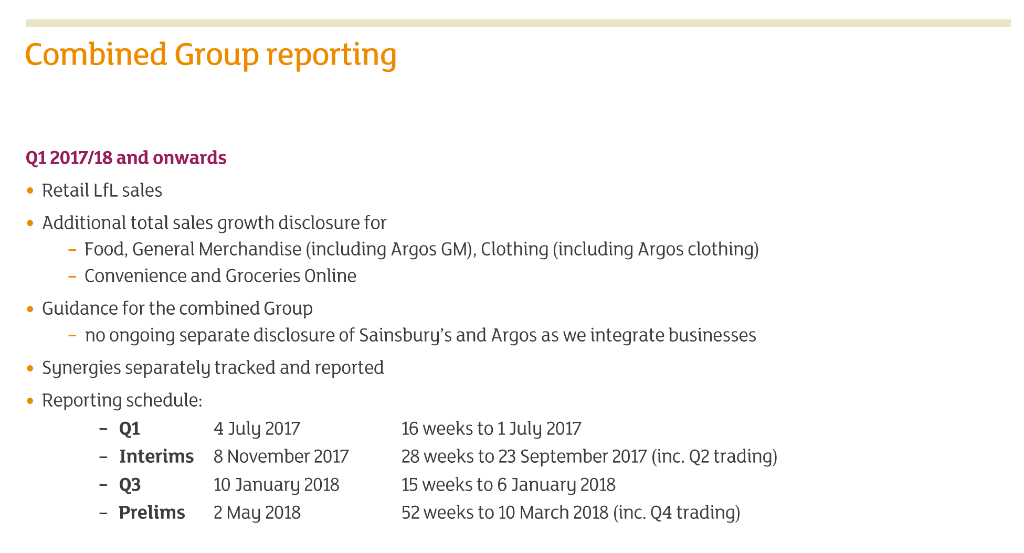
Their financial reporting changes too; with no split for Argos but splits for Food, GM and Clothing as a larger business. But savings are separately tracked to adjudicate the value of the wider deal.
Their Q1 is a mammoth 16 weeks long, which is almost a 1/3 of the year! This incorporates Red Nose day, Mother's Day, Easter and the start of Summer so should be nearing positive given the trade calendar.
All in all, fair play to Sainsbury's.
They have a strong plan for the future and Argos appears to be working where it's rolling, GM and Clothing are in good shape, as is online and convenience.
The core food business is declining as we expected and indeed have seen, but improvements in the day to day trading should start to alleviate the decline, especially if they get their own label work right in the coming year.
However, that's only part of the battle for food. The wider market conditions are still tough, competitive and the Brexit debacle with inflation adds another layer of complexity too....
Fun and games ahead!
Subscribe today to this service, today!
From the Grocery Insight newsletter archive, first sent to subscribers on 3 May 2017. Steve now writes at read.groceryinsight.com. See also the blog archive and briefings.