Tesco now charging for food click / collect?
20 March 2017
Click here for a free 1 week trial to this service.
Subscribe to this service here!
It appears that Tesco have started charging for their food click / collect service, local media (the Devon Live no less) have reported that customers are now being charged to collect their food shopping either on the day of the order, or indeed in the future.
It used to be free, with the deliveries charged for - but given that click / collect eliminated an expensive leg of the online shopping journey, the delivery. It seemed almost fair that customers didn't have to pay to collect their shopping.
Of course, there is the cost to pick / pack which is absorbed in the product margin / supermarket margin, but delivery is expensive. Vans, drivers, insurance, fuel and congestion charges.... The list goes on and on, plus you only add cost (more vans!) as you open up further capacity.....
So, click and collect was a push by Philip Clarke to try and improve online profitability, however customers in the UK have only ever known 'good times' of low delivery costs and convenient times, so it's difficult to then persuade them to drive to a supermarket in order to pick up their shopping.
But it has gained traction, still seems a distinct 2nd choice versus delivery - but the click / collect opportunities are everywhere with collections from convenience stores, smaller stores, rail stations, park and ride routes - via automated elements like Lockers, not having to rely on a person being there.....
Tesco dropped numerous car park based click / collect outlets in to aid their push, with delivery saver and free click / collect dangled for customers to switch in to collecting shopping themselves.
Recently, their introduction of same day click / collect was introduced with no charge (order by 2pm and pick up at 5pm). It looked as though Tesco were trying to utilise 'dead' time once colleagues (contracted to work) had completed the shopping by offering a same day collect service. Thus colleagues in store were then utilised to pick that shopping and operate the collection point.
Non food click/collect became chargeable (following the John Lewis model) with a £2 charge for anything under £30. However this harmed non food sales significantly; this charge was then abandoned for Christmas (timed with their Argos price push) and this charge hasn't returned, which helps the volumes - Express is key for this given their locations all over the place.
So to food; did customers really not know charges were coming? What's the logic behind the charge?
Are Tesco trying to reduce the volatility of online food as it grows (and grows) and restore a little bit of control from their end?
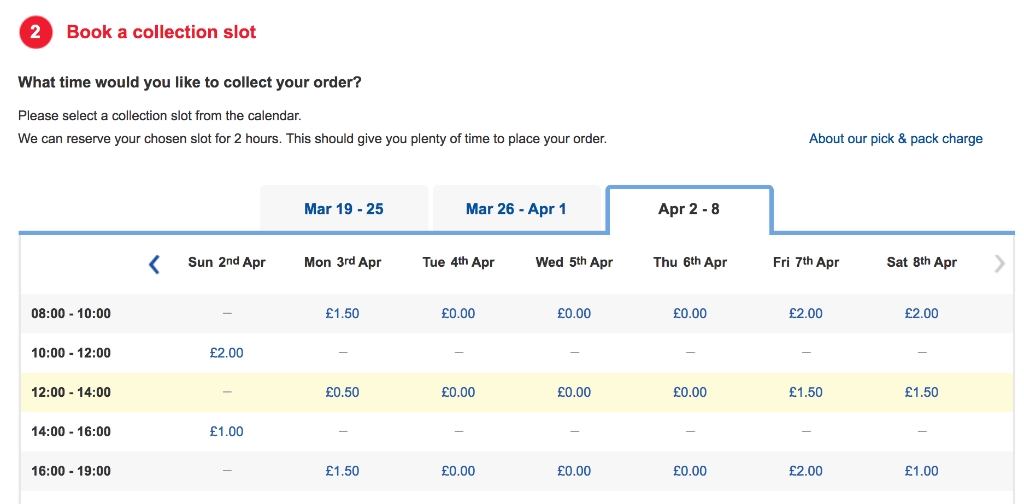
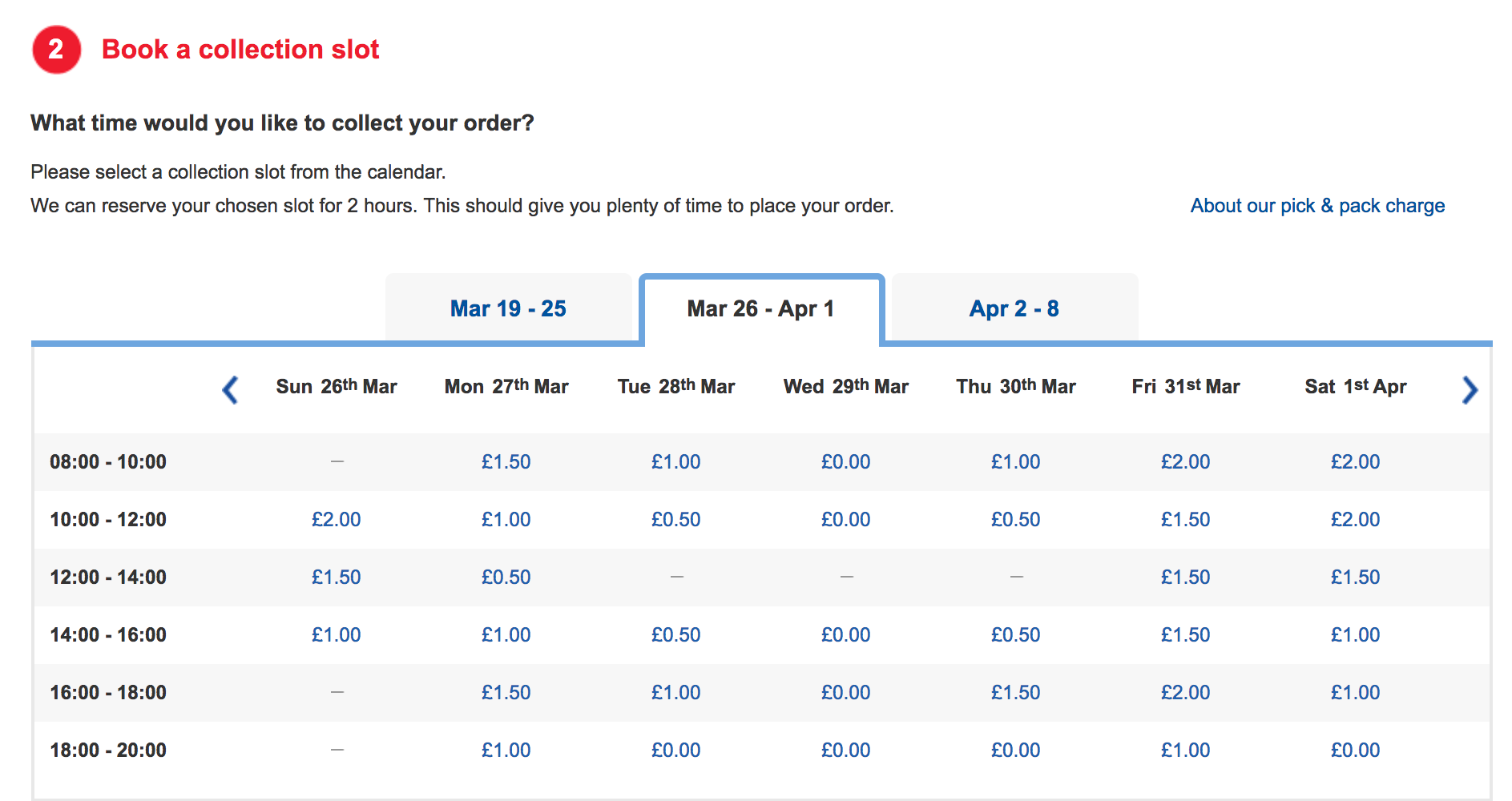
So we can see; two separate stores that are seemingly bringing a level of consistency to demand for click / collect. Having all time slots available, all of the time, for free means that staff costs are increased as Tesco have to staff up without necessarily having the demand.
The change enables demand to be smoothed from peak times, like Saturday - to quieter times where colleagues are around but may not be fully utilised.
But restricting availability in some stores until they're busier makes sense, the drawback is that Asda (for example) have full availability, at all times of the day in nearby stores and are also charging £0.00 for collection....
Two stores here; one has relatively restricted availability but quieter days are free, whereas the obviously popular times carry a charge. Whereas the store with more availability doesn't offer much 12-2 which is presumably to ensure colleagues can get their lunch and shopping for later in the day isn't impacted?
There are some stores that were never popular for collection, and their 'pod' has been removed.
There are charges aplenty for collection, which was never the case. Tesco helpfully point out why there are charges with this questionably worded message on the website.
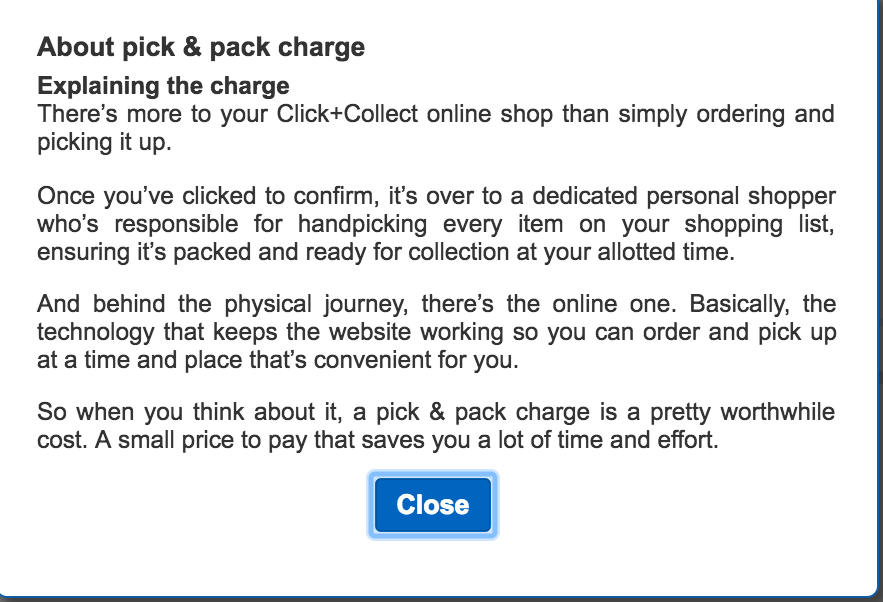
Not the greatest message in the world, it could be worded so much better.... Basically quieten down and pay!
A worthwhile cost it may be, but it's still the customer paying more. Telling them that the technology to power the website is worthy of paying doesn't really resonate.
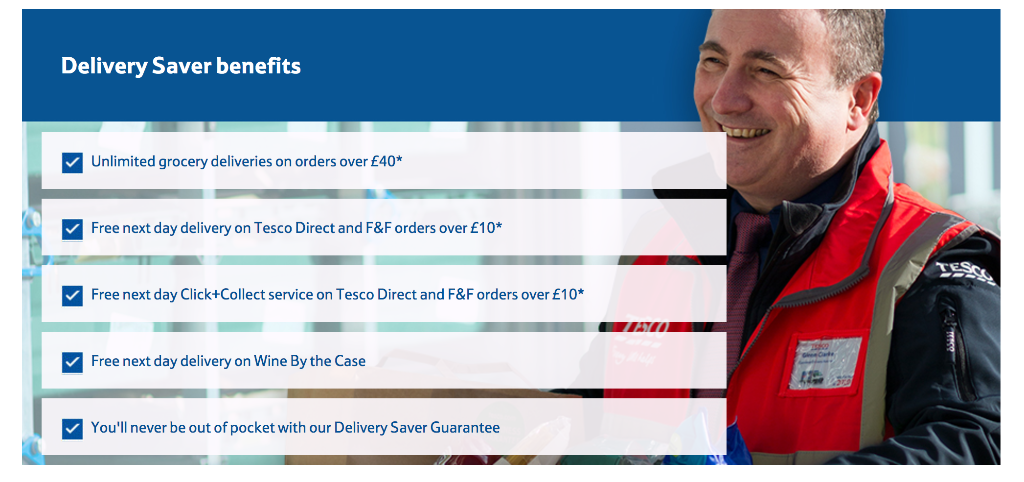
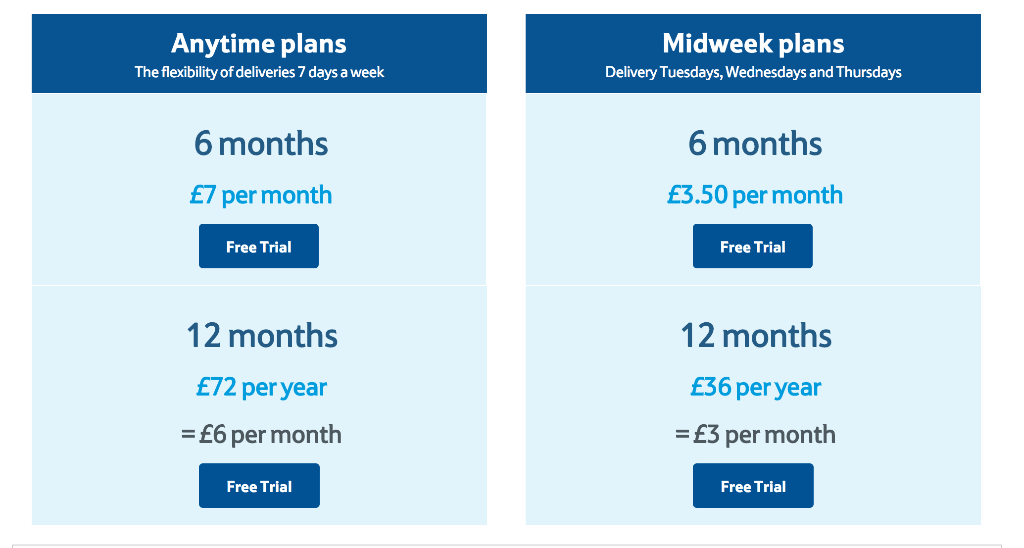
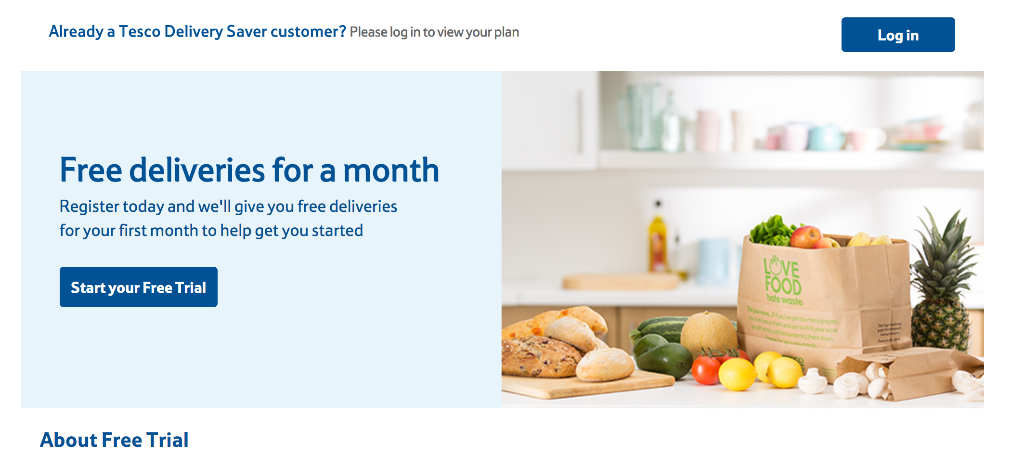
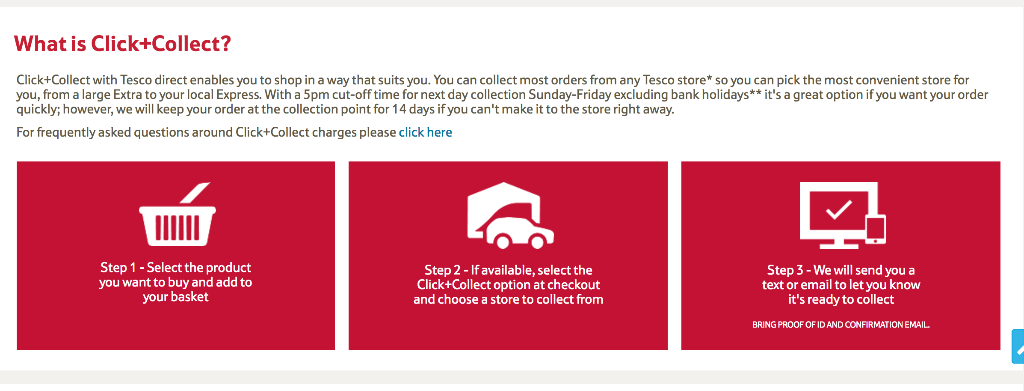
The ambition for Tesco will be to push people towards their delivery pass, rather like a gym subscription, you sign up and pay whether you use it or not. Cancelling is a little easier and there's a free month to kick off with too!
The free click / collect service for Direct doesn't make sense as it's seemingly free anyway. Presumably the £10 limit is for all customers. But the there's no mention of click / collect on the delivery saver for food....
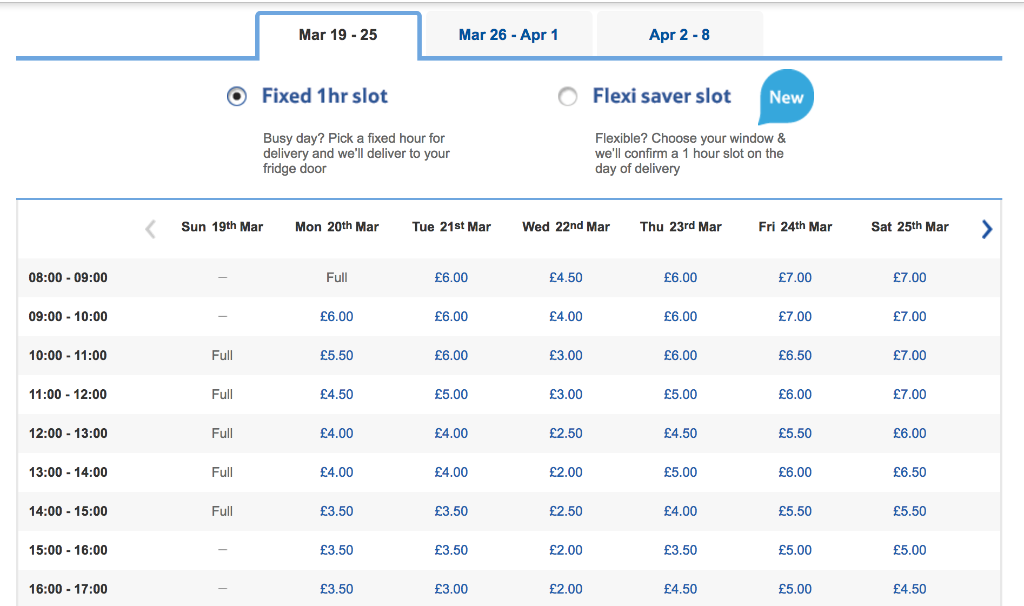
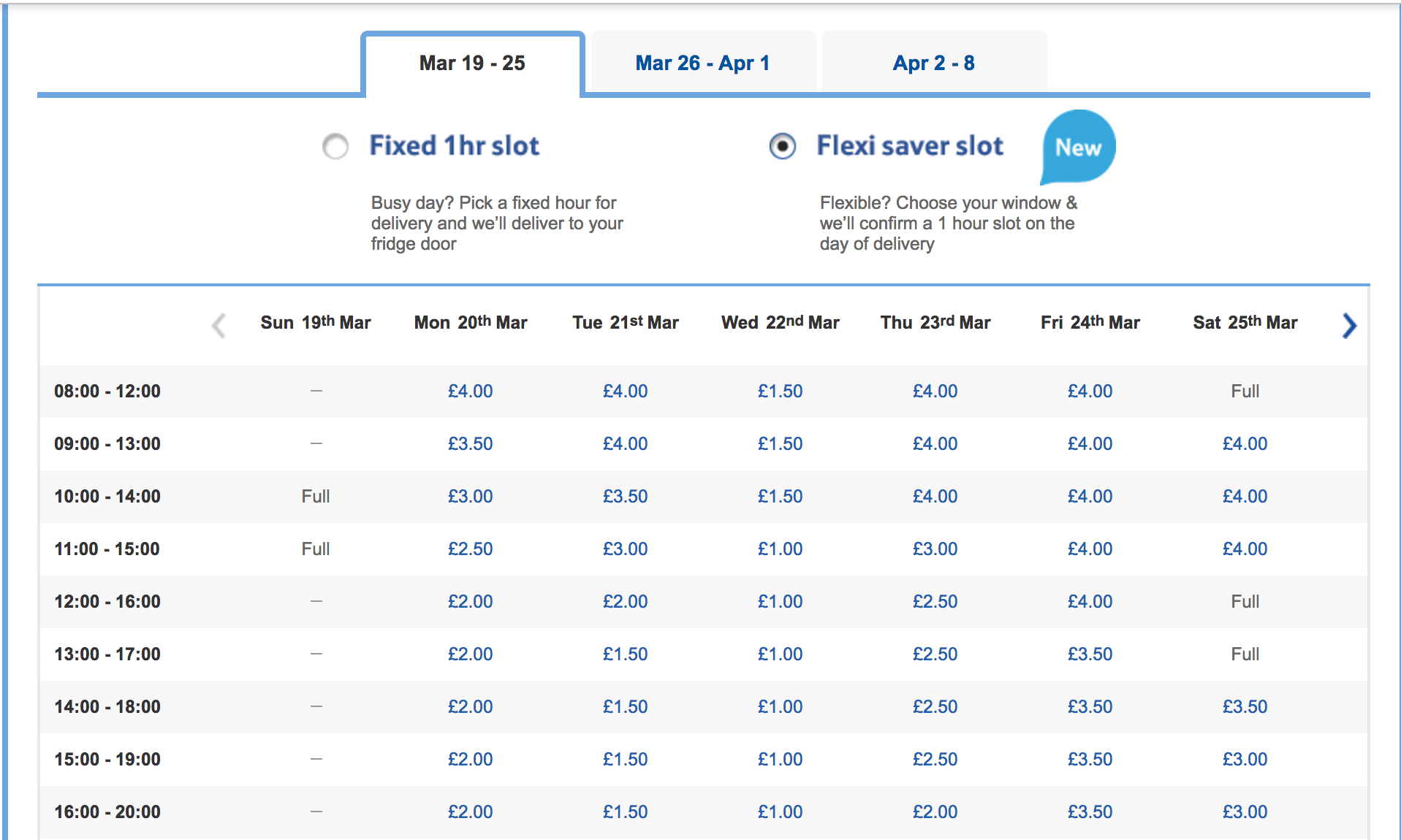
Without the delivery pass of course, delivery prices are high, which of course, entices the customer to sign up for the delivery pass.
They're then far more likely to order with Tesco given they have the pass, as a month's delivery pass actually costs less than one delivery on a Saturday this week.
If we consider the delivery costs, not that I often do at close quarters... The service has become too good for customers really, as retailers battled to compete in ever greater ways, delivery slots were reduced to an hour and customers were rewarded if the delivery was late too.
Customers who shop online habitually are then in need of a 'top up' on a weekend, so getting their loyalty via online means they're far more likely to then use the physical store when they need more shopping.
But the online customer is typically very, very demanding. The service expectation (customer) but also the online service delivery has set the bar very high indeed. It's an open market because the supermarkets are driving to you, there may be a Sainsbury's 30 minutes away, too far to drive to. But if they're happy to come to you - then it change the landscape.
There is no expectation that the online shop will have substitutes, 100% availability is expected, longest shelf life possible (nothing that day or day after), best quality product and there is also no tolerance for a late delivery either.
Factor in that the customer pays the same prices as a customer in store, in some cases a low delivery charge and the retailer has to pick and pack the shopping too.... It's nearing a zero sum game.
Tesco it appears are now trying to have customers pay for this level of service, which whilst questionable given competitive forces, from a business viewpoint is quite practical. I.E. join the preferred scheme or you have to pay a fair price for the delivery on a peak day.
Their 'flexi saver' delivery slots are a way to reduce the pressure on Tesco themselves and also allow for the load to be spread out across 2/3 slots, rather than overloading 1/2 popular slots.
This is basically a 4 hour window that the customer is happy for a delivery to come in, costs are a bit cheaper and it means that Tesco can organise routes better and make things more efficient. They are told on the morning which 1 hour slot their delivery will arrive, but it does give a better level of flexibility for Tesco.
The scheme looks to be an airline method of selling so many 'cheap' seats before the next price bracket becomes available. We can see that some of the cheaper, flexible slots (4 hour window) have already been taken given the price differential versus the 1 hour slot.
It's no bad idea this from Tesco, enables them to utilise their colleagues and vans at all times, presumably also using technology to flex pricing based on demand / supply.
Colleagues are expensive, and becoming more so. The last thing needed is colleagues being paid when the work isn't there, or they're in the building at slightly the wrong time.
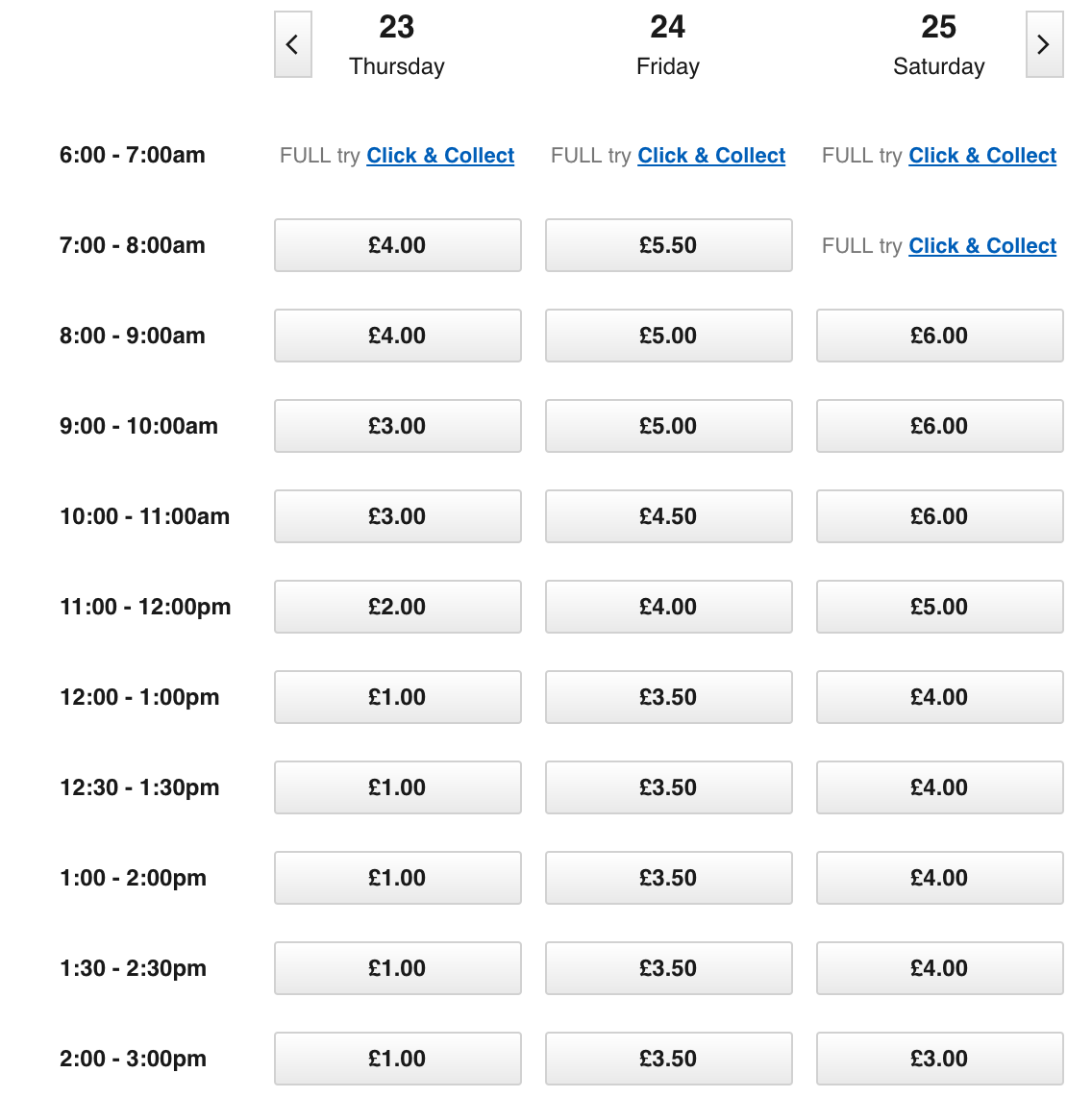
Asda have slightly lower charges on the day for delivery but are still north of £5 for their Saturday deliveries, with some slots already full. They also have a delivery pass option which is clearly very effective, those customers probably account for the slot being full early on Saturday too.
The one area where Asda are very strong is click / collect, they have always led the market here with tech based solutions to make collection efficient and easy. Their work has seen Tesco and Sainsbury's eventually catching up with customers announcing their arrival, use of digital screens and waiting areas, rather than a colleague stood at a desk, or in a van waiting.....
Their drive thru outlets and use of lockers have been very consistent and although their ambitious push using petrol stations and other tertiary sites like park and ride areas has been stopped, they were very much pioneers in this area.
Indeed Wal-Mart are now benefitting as the Asda team responsible are over in Arkansas pushing the scheme out to stores across the US.
For Asda, Click/Collect is free and remains that way seemingly, despite changes elsewhere. Perhaps the technology investment has already paid back, meaning the numbers make more sense for them.
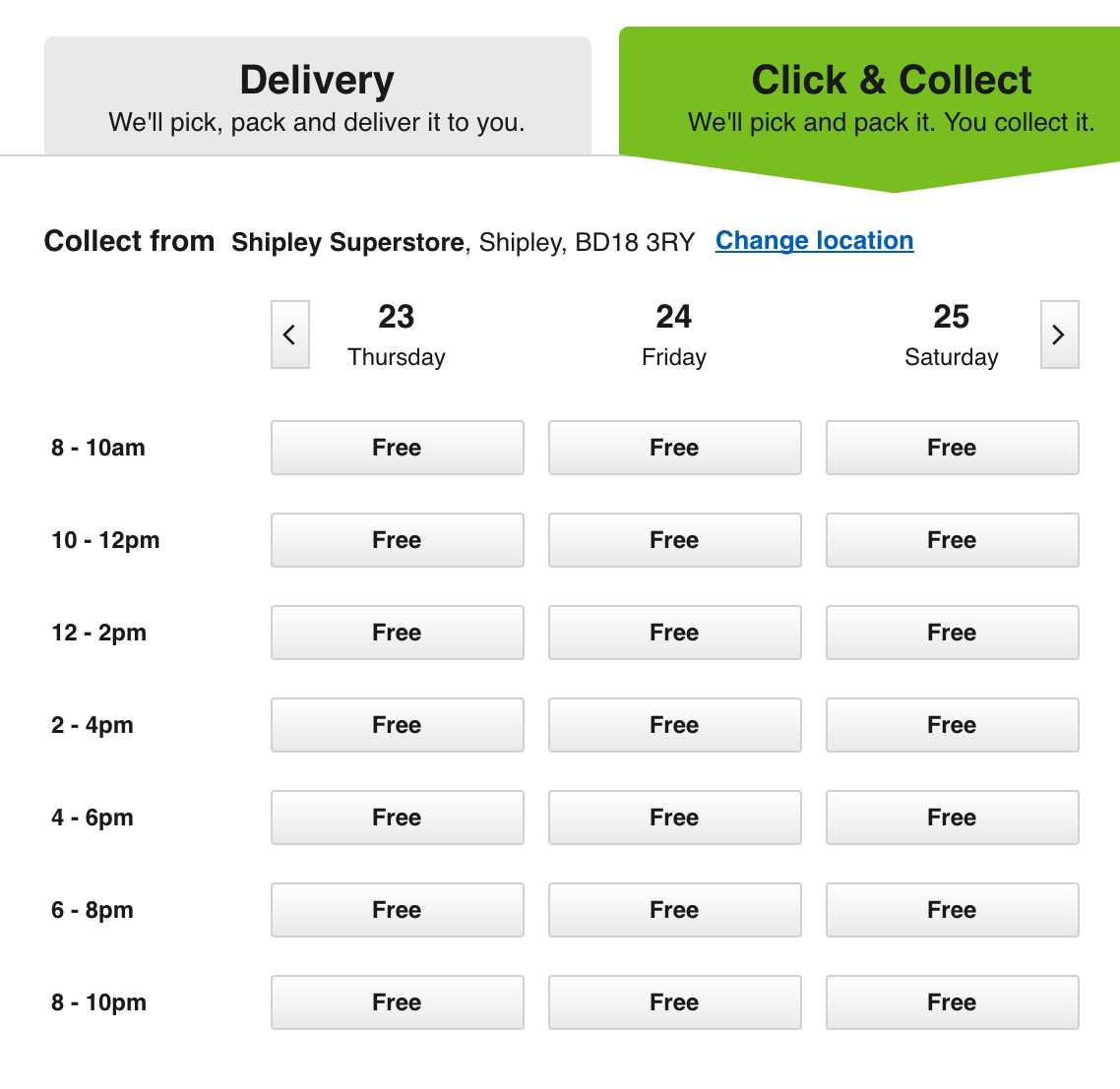
Asda clearly happy to stump up the cost for technology and indeed colleagues to pick and pack the shopping if the customer is coming along to pick it up.
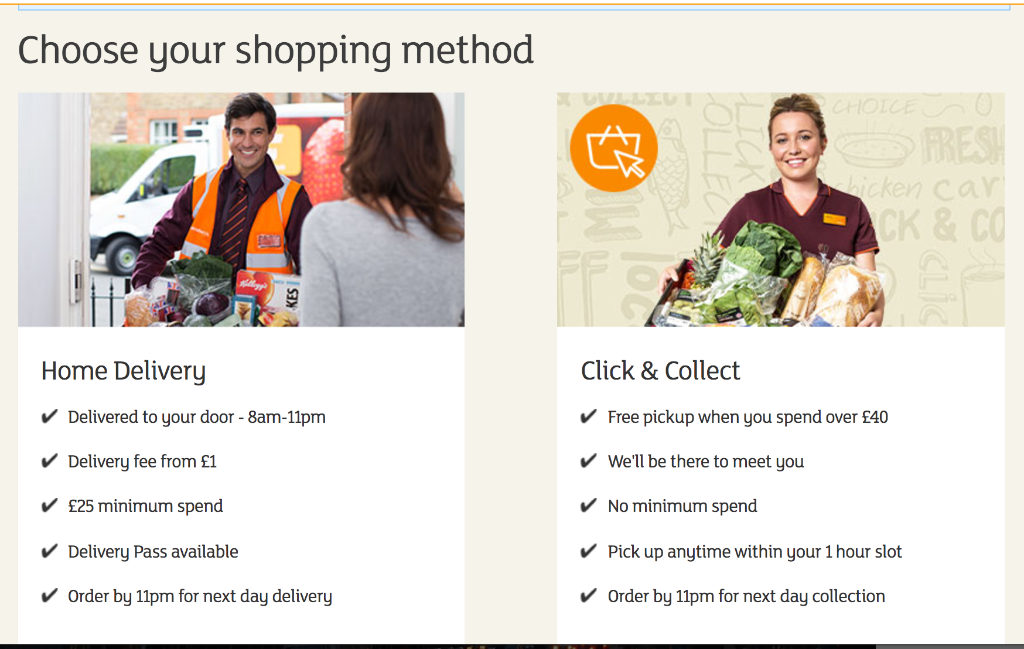
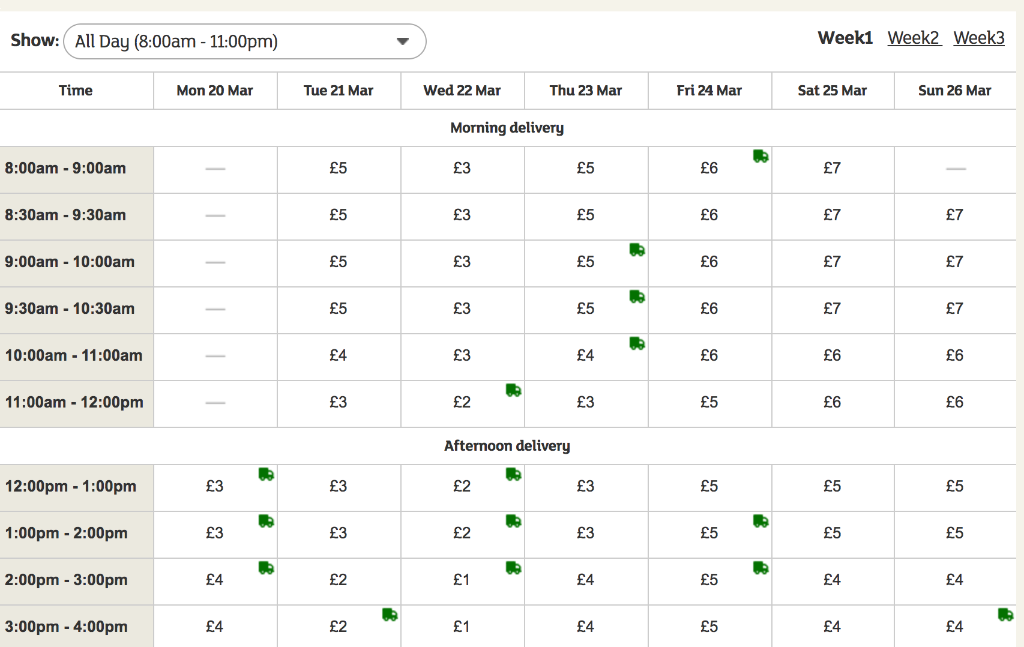
Sainsbury's also charge a decent rate for Saturday, based on demand of course, these figures for all retailers could change depending on store selection but it really is notable how £7 doesn't now seem overly high across the market.
Some customers must pay it too, but I'd wager it's about getting customers in to that space of the delivery pass / subscription offer. £6 for a full month's worth of deliveries is cheaper than one delivery on a Saturday, so it makes sense.
It also knocks down a barrier, with a customer unlikely to then shop around given they're committed to deliveries with one retailer - thus they benefit from the shopping they do. A bit like Amazon with Prime, they make it so easy, it's the default option for most things for many people (plus price etc).
Sainsbury's are also pushing their click/collect offering, not a massive deal by any stretch yet. One store near me still has the man sat in the van, waiting in the car park. Odd, feels like we've gone back about 10 years.
Happily a store over the M62 had two parking spaces and an intercom so you could tell the store you'd arrived to pick up the shopping.
It's free for customers spending over £40 and there's 1 hour slots and a cut off of 11pm for next day collection.
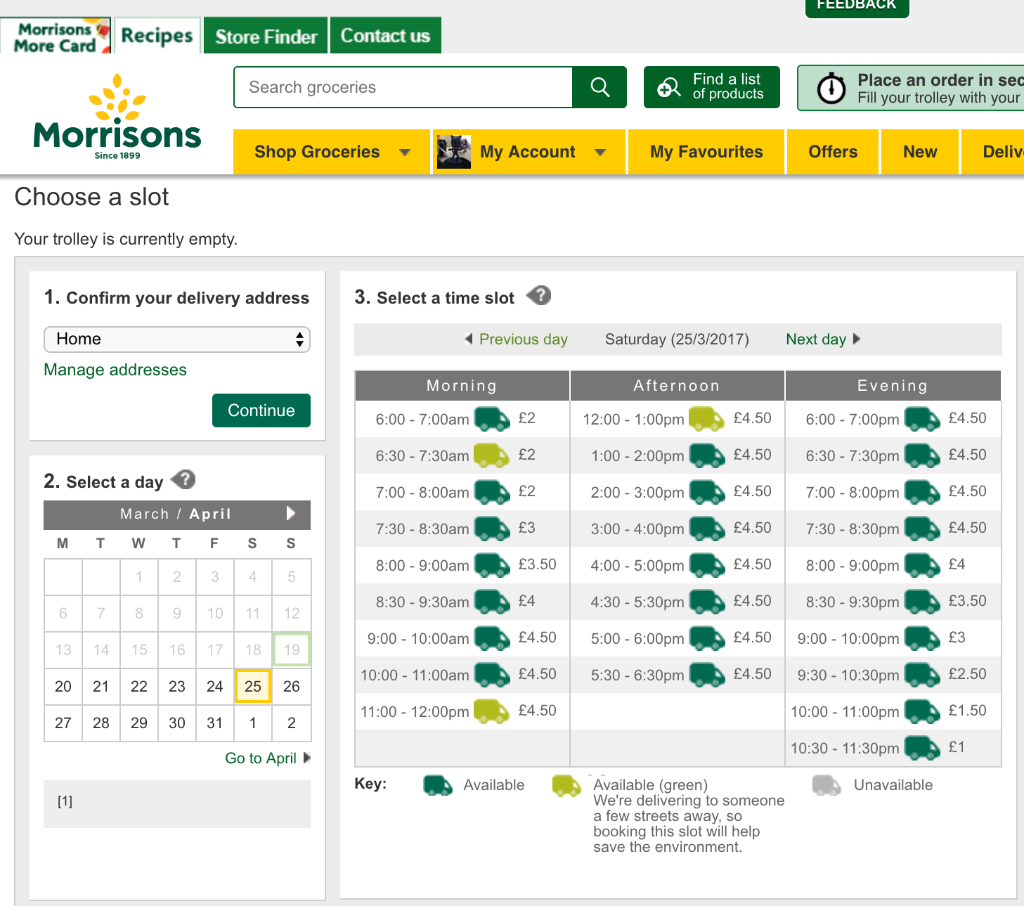
Morrisons offer lower delivery rates but no click / collect service just yet, they too trade on 1hr slots but expand that to 30 minute intervals on an evening.
With online kicking off in stores where they're not represented geographically, click / collect could well be a future opportunity.
Prices are higher for the peak times but lower than Tesco, Asda and Sainsbury's, this could be a demand / supply / Ocado technology situation, rather than a concerted focus on a lower delivery price.
Of course the input costs are lower with Ocado based picking too... Tech rather than people...

Of course, Sainsbury's offer the £100+ customer free delivery anyway!
So, it's interesting that the economics are still not overly making great sense for online and deliveries. But click / collect clearly carries a cost too and Tesco are trying to recoup that cost by charging.
If the service is good, prices are good and customers are happy, then there may not be a notable drop off. But Tesco must feel they're in a strong place to introduce the charge.
Their smoothing of demand by offering lower rates for the 4 hour slot (after the market moved en masse to 1 hour slots) seems a wise move, but a reminder that online still carries a huge cost.
Anything that can be done to reduce the demand volatility and enabling better usage of colleagues and utilisation of costs is a smart move.
It's whether those customers who are initially disaffected with the charges, who decamp to Asda / Sainsbury's et al are enamoured enough with their retailer of choice.
Or whether they'll return, 2-3 weeks in, viewing £2 as not a huge price to pay for the service they receive.
That's the acid test. Sir Ken Morrisons used to say 'You're never quite as good as you think'. Will Tesco find this out to their cost?
From the Grocery Insight newsletter archive, first sent to subscribers on 20 March 2017. Steve now writes at read.groceryinsight.com. See also the blog archive and briefings.