Tesco/Booker and B&M results
17 November 2017
A busy time in the market this week with Co-Operative and Nisa having their deal ratified by the Nisa members (by 0.8%) which will lead to the Co-Operative looking after Nisa in terms of supplying their own label products to the Nisa business.
The main deal announced this week of course was Tesco / Booker can go ahead without any further ratification from the CMA themselves. They are seemingly happy with the wider convenience situation and the multiple brands that will form part of the convenience sector for Tesco/Booker.
The wholesale situation is what the CMA have concerned themselves with, and with Booker having c.20% share, they are by no means dominant in the marketplace.
So the CMA are happy with the fact that convenience retail could be dominated by fascias either with Express or One Stop, then you have the rest of the banners such as Londis, Premier and Budgens too. The question then arises around the customer and how that works, for example, if they are to be charged more in a Premier store than a One Stop franchise, yet these are owned by the same firm?
However clearly the CMA don't think this is a huge problem and market forces will take care of this, in that the customer retains choice, which in many cases there is enough choice with a Sainsbury's Local or Co-Operative store nearby too.
Equally the operators need choice with the banner they choose to align themselves with, and with the Co-Operative moving with Nisa, this should hopefully occur as franchise options expand with new operators, Sainsbury's Local may also choose to move in to this sector and Morrisons have an offer with Safeway of course to come down the track.
The key questions here are around the Tesco / Booker wider partnership, the reason for the takeover / merger was that it would open up the food at home sector for Tesco, meaning they could bring scale to the Booker operation and hopefully have the Tesco business capitalise on some of the Booker success.
Additionally, we know that Booker metrics for deliveries are poor and behind equivalent performers in food retail, with on time deliveries below par. So Tesco can bring a lot to the party here too.
Overall, it's hard to make the argument that any independent retailer trading under Premier or Londis banner would not be improved by some Tesco input around ranges or store execution.
Another viewpoint was that if Tesco had been barred from taking any of the independent banners via Booker, they'd still have continued with the purchase, as Booker were always the golden ticket so to speak.
An intriguing view, perhaps we're all looking the wrong way?
Either way, the shareholders are not pleased and some of the non execs have been far from encouraging to Tesco around the purchase. All focus on 2018 as we see what Tesco make of their new partnership once the deal passes the regulatory ratification.
2018 will surely see further consolidation in the sector and it was amazing to see the impact that Tesco/Booker being announced had on the sector, struggles at Palmer&Harvey (Booker is a large part of their business), Nisa aligning with the Co-Operative (although by a Brexit margin of 0.8%) and further rumours around the sector too.
Will we see larger scale consolidation? Sainsbury's have always found it harder going in the north of England and Scotland (save a few stores) and with aggressive competition from discounters, Morrisons and Asda. Could we see parcels of stores being divested from retailers?
The challenge is that any lower footfall, lower sales based stores don't attract interest as who wants to take the unit? Save for discounters who are increasingly taking sites and popping up near these stores anyway.
I don't think anything is off the agenda in food retail, consider that we'd never seen a store closure until 2014.... Retailers will be looking to adjust their cost base where they can... Especially with more consolidation in the sector.
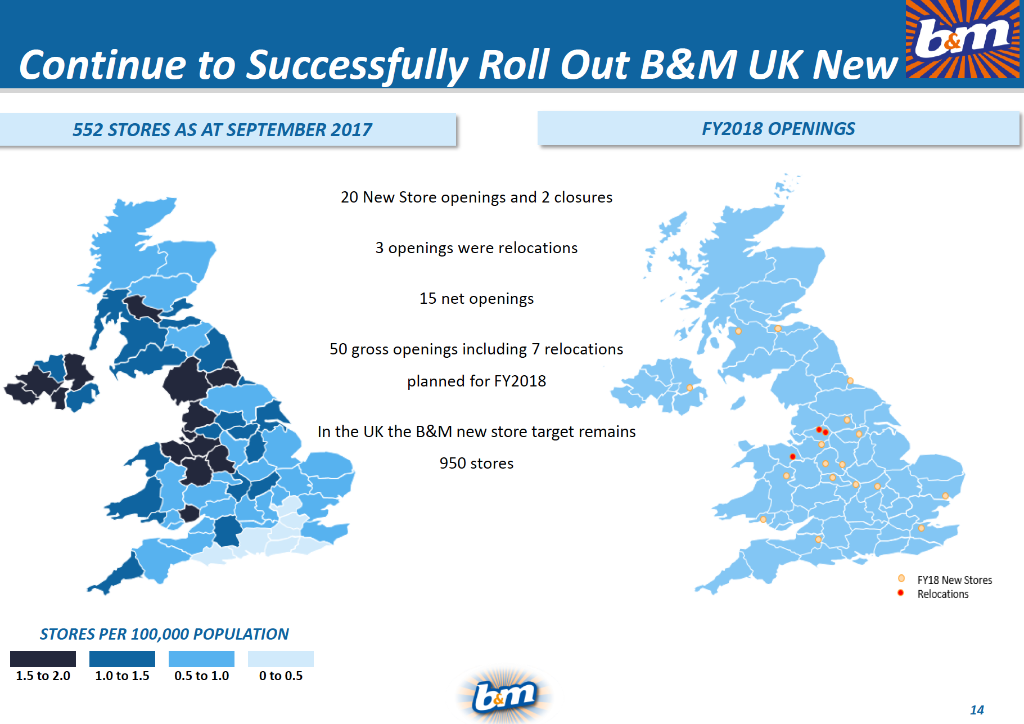
Speaking of space and under performing retailers, B&M are continuing to perform really well and progress their offer for customers.
Their results this week reflected a wider picture of growth in food but a slide in non food reflected the wider market, even for the likes of B&M who are seeing discretionary purchases fall too.
Their slide above shows that their target for stores remains at 950, with a number of openings, 3 being relocations shows that the existing unit was likely over trading. 7 relocations in 2018 again shows that their existing units are clearly popular and will benefit from the new space and larger stores.
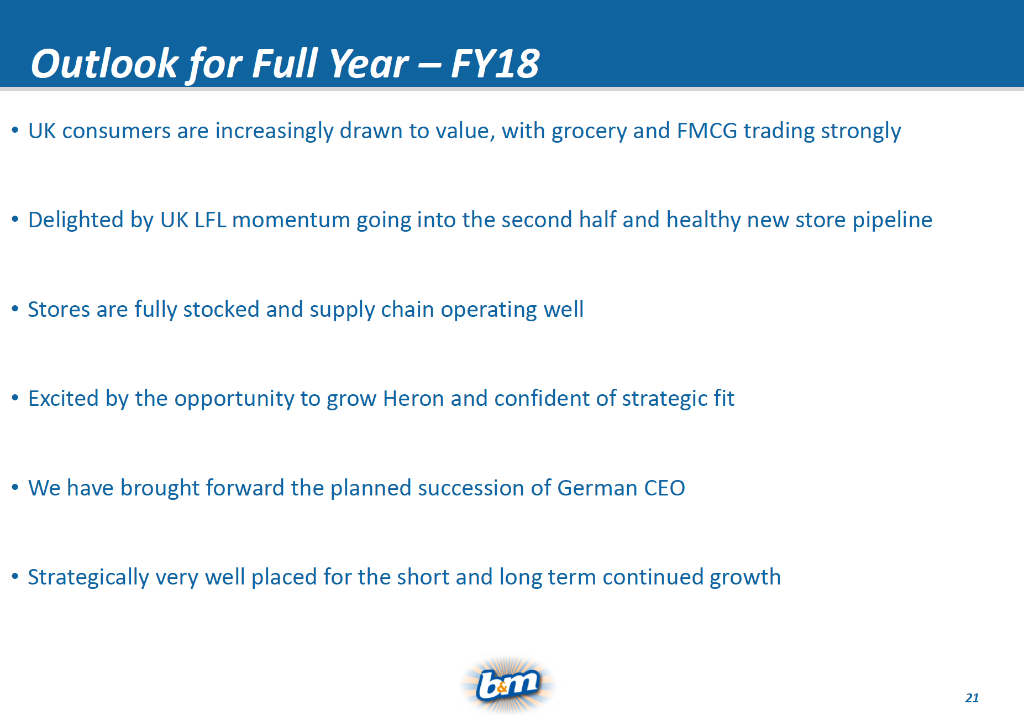
Their outlook for 2018 was very interesting too, as it notes that UK consumers are drawn to value with the Grocery / FMCG side of the business performing well, with customers reverting to behaviour learnt from the recession.
Heron Foods is another example of consolidation that was perhaps a cause of the Tesco/Booker deal, a smaller convenience chain in the north of England didn't seem an obvious target for B&M, but they seem keen to make the most of it.
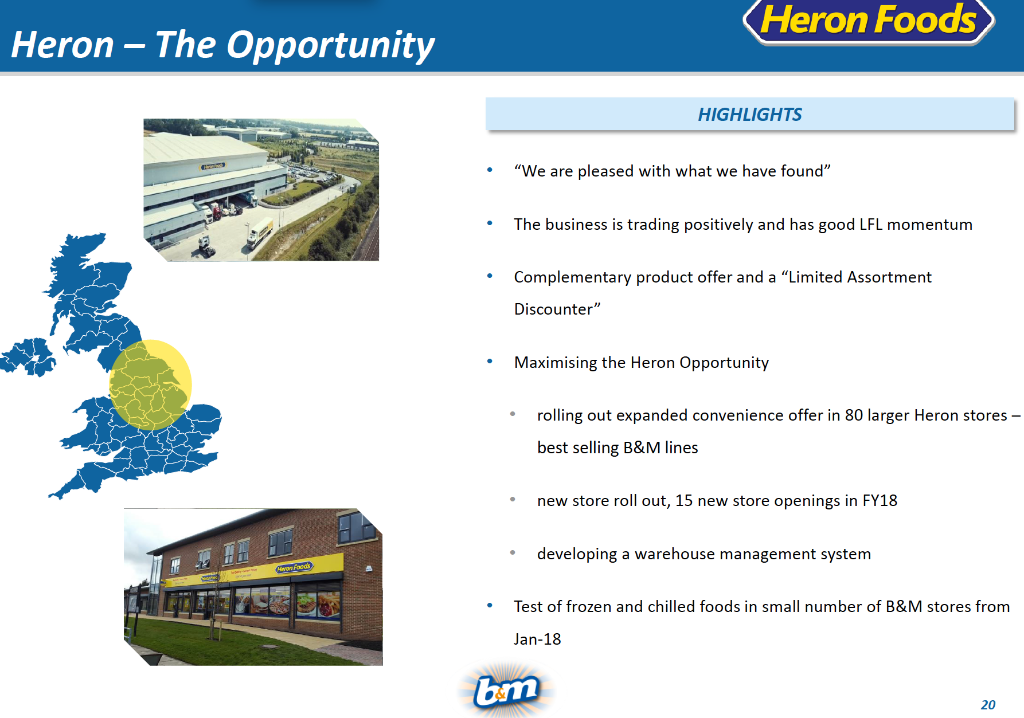
The Heron Foods slides were also notable from B&M, a deal that is bubbling away and save for a few B&M products arriving in Heron, we've not seen a great deal else so far.
The chain have a number of stores that are ex Woolworths in their location / size, a high street based store on the traditional village / smaller town footprint. These represent a good opportunity for B&M to drive further non food based lines.
80 larger Heron stores will benefit from this offer, with more B&M based products and non food featured. 15 new Heron stores open next year and some of these will arrive with the larger offer one would think.
Intriguingly, this purchase of Heron has led to B&M trialing frozen and chilled foods from January 2018, which will impact the food retailers....
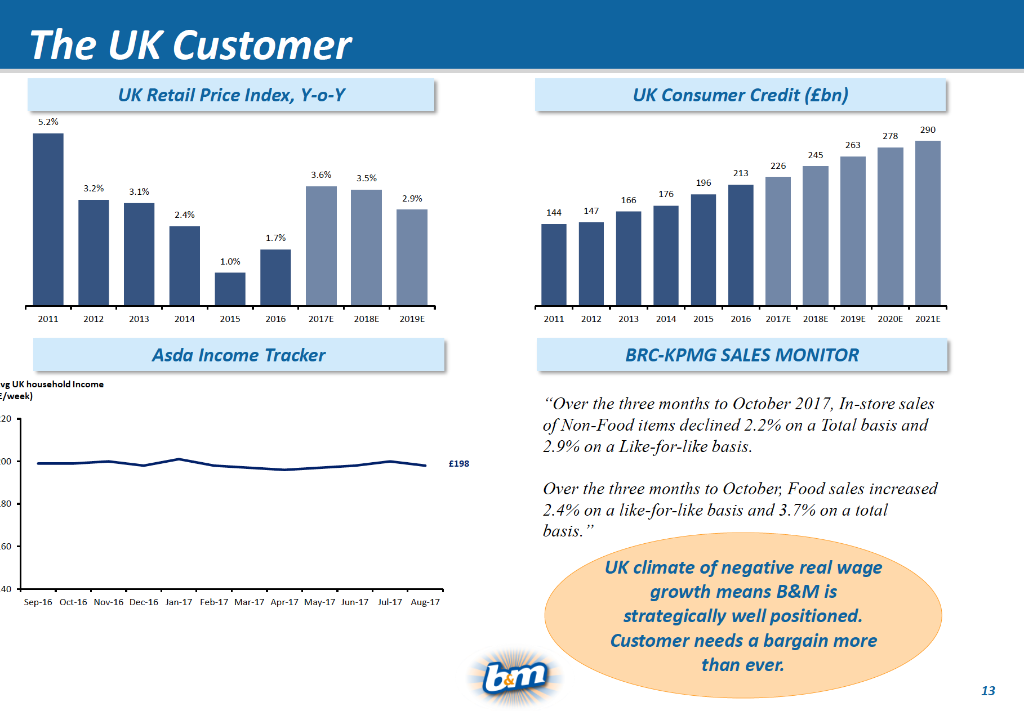
This slide says a lot in terms of the wider consumer finance picture, Retail prices rising, income remaining stagnant (using the Asda tracker!) and consumer credit on the rise with a forecast out until 2021 showing a rising trend.
Non Food declined 2.9% on a like for like basis, even in B&M which shows customers are pulling back on discretionary purchases, even in a store like B&M where prices are known for being low.
However their food sales are up 2.4%, of course inflation plays some part. But B&M don't have a discernible range of fresh foods where inflation has been keenly felt.
For 2018, that slide perhaps shows the challenges that the retailers face, it isn't just the Aldi / Lidl element.... It's increasingly about B&M and Home Bargains - those value based retailers that sell a variety of products, offsetting their low margin food / FMCG products with higher margin non food.
Any move to increase food ranges in B&M will potentially impact the food retailers within Grocery and Impulse certainly. Customers take a chance with these stores, they may not find a jar of Coffee, or bottle of Shampoo that is the 'right' price for them when doing their shopping, or they may prefer a branded product.
So they take a secondary trip to B&M, knowing they'll be some sort of Coffee in stock, it may be a foreign sourced equivalent, irregular pack size or similar. But it will be lower in price than their supermarket of choice. Even where that supermarket is on offer....
That's the challenge, and more to do in this regard by the retailers one suspects.
All of this means there is an intriguing next year in prospect..... Again!
From the Grocery Insight newsletter archive, first sent to subscribers on 17 November 2017. Steve now writes at read.groceryinsight.com. See also the blog archive and briefings.