Tesco - Half year
5 October 2016
Subscribe to this service here.
After the intriguing non food overview yesterday; more focus on the Tesco food push today and more examples of really credible work too.
Dave Lewis has been absolutely clear from the start around food and that prices would come down, but there wouldn't be a campaign about it in the wider world. He's been true to his word, bar brand guarantee - when was the last time there was ever anything around price in the press / TV from Tesco?
No 'staying down', nothing around x amount of cuts since 2014 and x prices left down and not rising. Nothing.
It's all been about reducing prices at the shelf edge for customers to see themselves, often there will be a simple barker with a 'was / now' price bubble showing a price cut.
These typically appear after there has been a range review; some own label lines will come down in price and be flagged with a barker to highlight the cut.
More space for the own label means better availability in the day and increased exposure on shelf for the own label products for the operators.
The customers then see the own label in the prime locations on shelf (eye levels / above / below) which enhances the chances of purchase. Aisles being branded 'galleries' for the FMCG companies are over in many cases in Tesco.
All this feeds in to increased volumes for own label, lower buying prices thus feeding in to a lower price at the shelf edge. Tesco also control ingredients, branding and pack sizes etc of the own label, rather than being a hostage to brands.
Of course, the exclusive nature of own label to Tesco means that it seems a no brainer.....
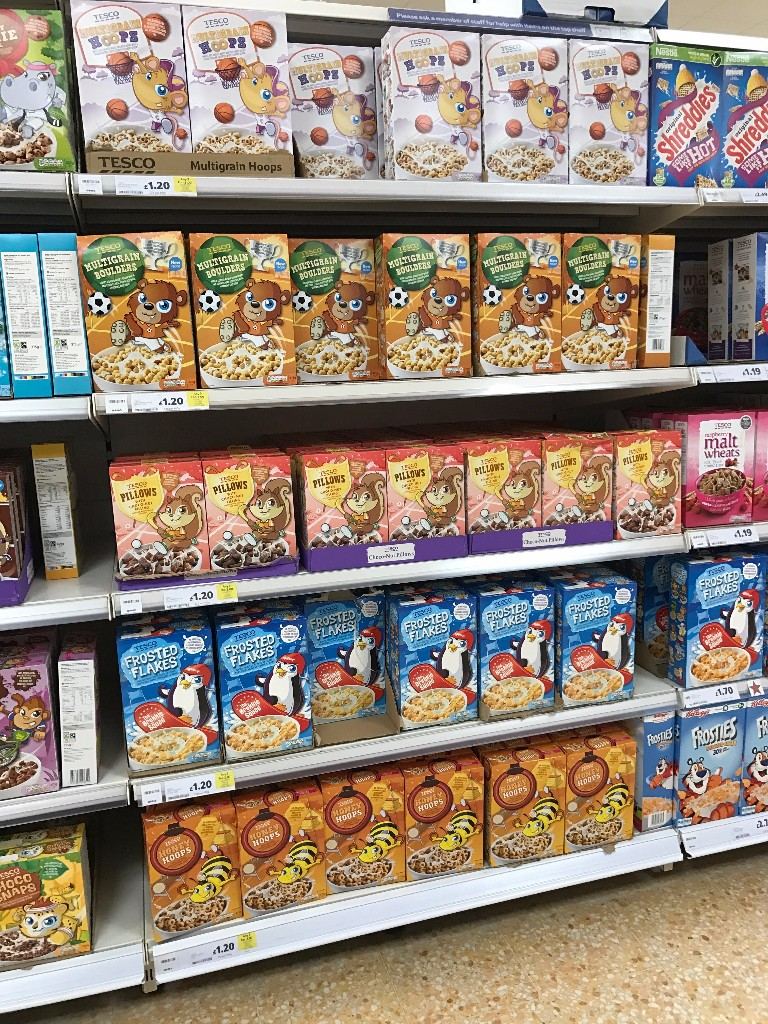
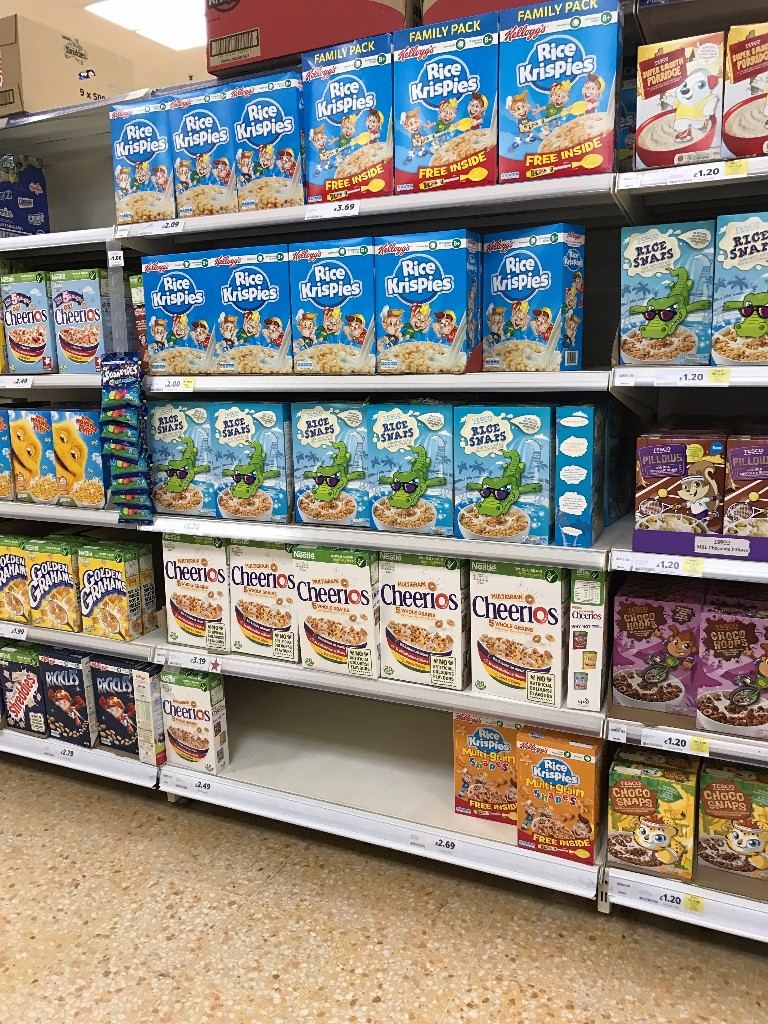
Many categories have benefited from the exposure in the own label categories, it means the buyers have to work harder, improving the own label proposition rather than relying on monies from branded suppliers though.
That's no bad thing, but it's a brave business to push the button as commercial income as a share of profits was significant in recent times, for all the retailers as they battled against discount.
But investing in own label and giving space up that otherwise would be relatively lucrative for the buyer to sell to suppliers is the right, long term strategy.
Cereals is a category dominated by Kelloggs, Cereal Partners (General Mills) alongside Quaker et al. Therefore a fair chunk of cash is available from competing suppliers wanting prime space and location in aisle (even down to the bay - middle of aisle etc).
But Tesco in the images above have moved away from that mentality and prioritised their own label offering alongside the equivalent branded line.
As we can see - typically you'd see a solid bay of Kelloggs Special K and other brands to allow their bays to be signposted, however there isn't much evidence of this at all.
Indeed own label dominates individual bays and occupies the middle / eye level shelves with brands sitting at the bottom shelf in some cases (Cheerios / Rice Krispies Multigrain).
A solid bay of Kids' own label Cereal is the 'norm' due to the deal (3 for £3 etc) to provide value for parents.
However - the picture below is even more striking.
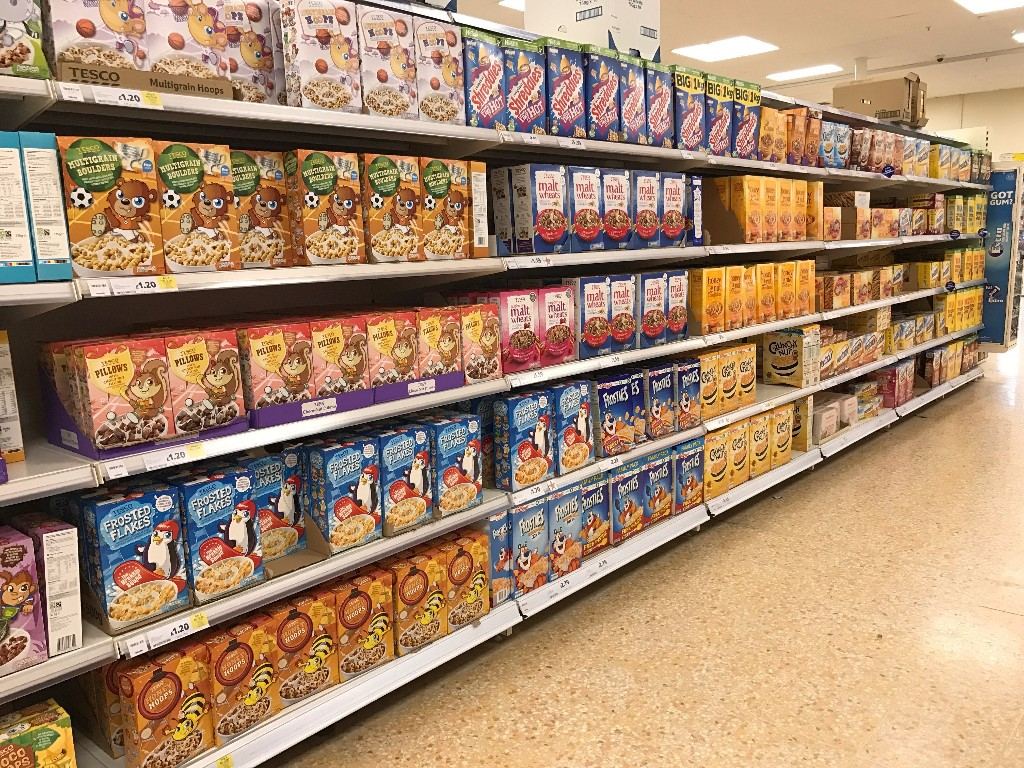
Looking at the high shelves, top / below / middle is dominated by own label products.
The branded equivalents are pushed down the pecking order, not out of the way but occupying space you would typically find the own label lines sited.
Very bold and one of the best representations of their work in picture form. Sure you can quote '%' of range reductions etc, the reality is this for customers and with the pricing sharp, value is pushed in to their face.
They see the lower price of own label, rather than the £3 (off promotion) Kelloggs that can hurt price perception should a promotion not be active.
Even if the customer decides to purchase the branded line, they have brand guarantee at the checkout that reduces their bill in any case should the overall shop be cheaper (brands) elsewhere.
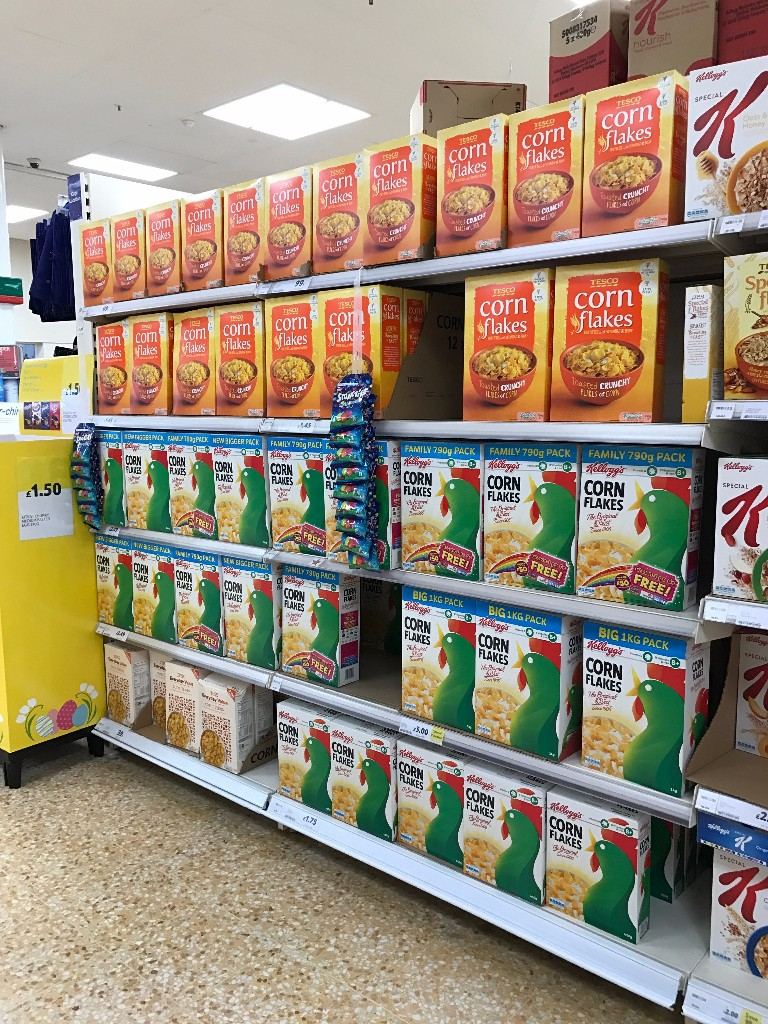
Price differential (Tesco.com - 3/3/17):
Tesco OL Cornflakes 500g - £0.99
Kelloggs Cornflakes 450g (note 50g less) - £1.75
Tesco OL Cornflakes 750g - £1.45
Kelloggs Cornflakes 790g (note 40g more) - £2.49
Simple for customers to see where the value lies?
Despite farm brands replacing value tier in Meat, Fish and Produce and performing very well, there has been little sign of a similar range coming in elsewhere.
Of course Tesco have a history with their discounter brands at Tesco campaign way back in 2009 (or so). Ahead of the curve? Absolutely but the discounter scale wasn't yet enough to justify it to customers, so it became an exercise in duplication and didn't have a great deal of relevance.
However if you consider farm brands and the impact that's had on Tesco themselves (deflating their own categories given Farm brands are cheaper but also seemingly equivalent quality to core mid tier)... The farm / fresh food Tesco branded exercise may well attract further interest elsewhere, particularly if it was pegged at the discount price.
But Value remains, tucked away at the bottom of Cornflakes here, but Kelloggs occupy 3 shelves here, own label Cornlakes sit directly above - in the customers eyeline and it's these lines they'll see first ahead of any brands.
Given the openness from customers towards own label now (Aldi/Lidl have done lots of work here for everyone), there is a higher chance of these lines being purchased given their lower price versus branded equivalents.
Should the product be acceptable to the customer (and Tesco will have done work here, given the exposure on shelf, what's inside has to match up). Then the customer is likely to switch in to Tesco own label and thus become 'locked in' to Tesco....
It's harder to make the case to shop at Tesco purely because the own label Cornflakes are good, as equivalent ranges are probably the same, but a layer of innovation and some truly remarkable products for seasonal events (Mince Pies etc etc) and suddenly the proposition becomes ever sharper.
Just sort the non-food out and they're heading very much in the right direction!
Of course Cereals are a high level example, and it's a category that is relatively simple to replicate versus branded lines. The trick is in other categories - cleaning for example where branded lines are heavily promoted and well marketed - thus driving a perception of power and effectiveness versus own label lines.
But the discounters do it, and Tesco can too. In many cases, they already are.
It's not just the wider market who should be concerned with the rate of recovery in the Tesco business, but also branded suppliers it seems.....
Even the 'easy' money isn't necessarily going to be taken by retailers any longer. The focus is on everyday value. if not EDLP.
Promotions are a part of that, but to focus control on own label, where the control is for the retailer is a very wise move indeed.
From the Grocery Insight newsletter archive, first sent to subscribers on 5 October 2016. Steve now writes at read.groceryinsight.com. See also the blog archive and briefings.